 blog
Buy Heavy Base Whiskey Glasses Online: 2026 Guide
Table of Contents
- Why Heavy Base Whiskey Glasses Change the Pour
- Crystal Clarity and Lead-Free Glassware
- How Long Does Opened Bourbon Last?
- Best Whiskey Glasses for Bourbon Tasting
- Weighted Bases, Stability, and Ice Sphere Sizing
- Cleaning and Care for Weighted Crystal
- Buying Heavy Base Whiskey Glasses Online: What to Check
- Frequently Asked Questions
Last Updated: September 13, 2026
Why Heavy Base Whiskey Glasses Change the Pour
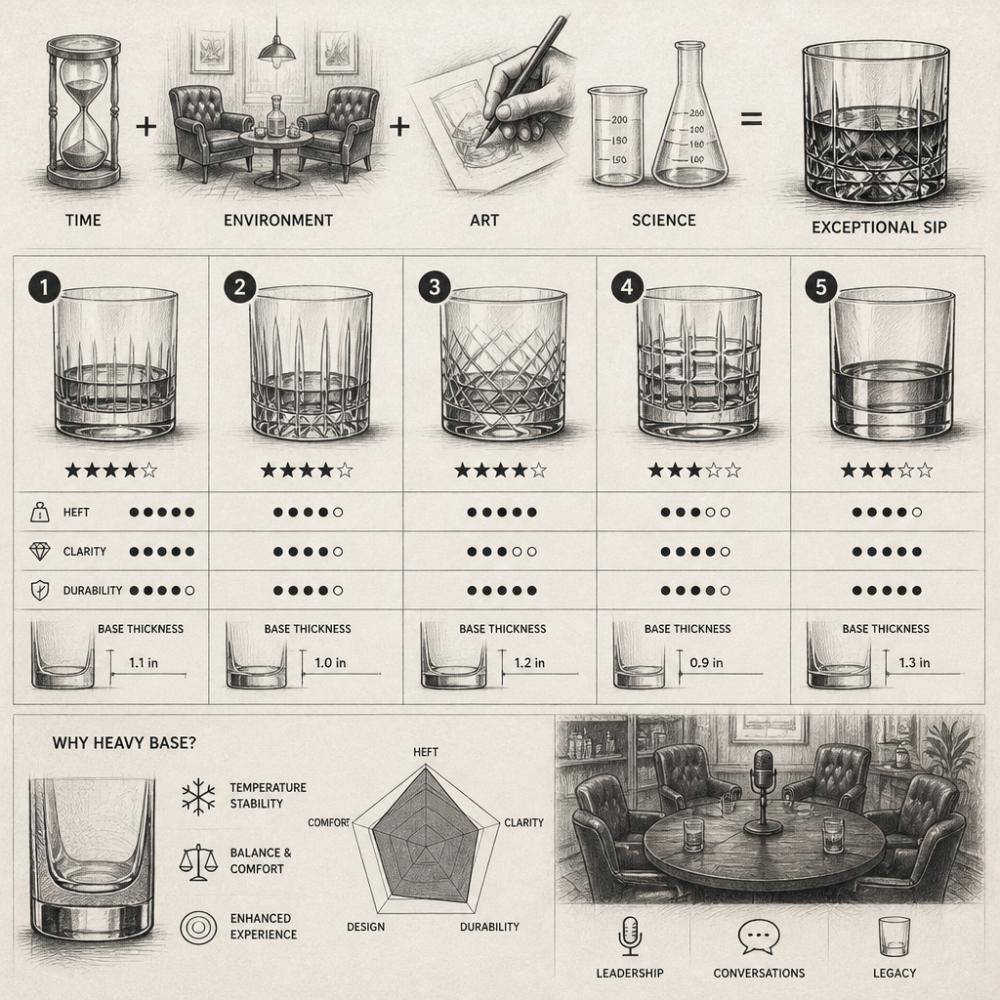
When you buy heavy base whiskey glasses online, you are choosing the environment where a conversation happens. Leadership and sipping fine bourbon share the same architecture: both take time, the right room, a little art, and a little science.
The Pour collection was built for leaders who treat a pour as a pause rather than a performance. A heavier base lowers the center of gravity so the glass resists tipping, slows heat transfer from a warm hand into the whiskey, and nudges the drinker to cradle the base instead of gripping the bowl.
How a person holds a glass determines how much their hand warms the spirit and how much aroma reaches them. A heavy base nudges the grip downward, away from the liquid, so the pour stays closer to its serving temperature.
Below, this guide covers what separates a genuinely weighted glass from a decorative one, how to match glass shape to pour style, and what to verify before you buy heavy base whiskey glasses online.
Crystal Clarity and Lead-Free Glassware
Clarity is a quality signal you can see before you taste the whiskey. Lead-free crystal glassware is formulated with alternative metal oxides, such as barium or zinc, in place of lead oxide, which lets it be thinner and more refractive without the health concerns of lead leaching. For nightly drinkers, lead-free is the correct default.
The practical difference shows up in three places:
- Refraction: Lead-free crystal bends light more than standard soda-lime glass, so the whiskey's color reads deeper and more saturated.
- Rim thickness: Crystal can be drawn thinner at the rim, which changes how the liquid enters the mouth and how aroma escapes.
- Weight distribution: Better crystal allows a thicker base and thinner walls in the same glass, which is the entire point of a weighted tumbler.
The U.S. Food and Drug Administration guidance on lead in food-contact materials is worth understanding if you plan to use a set regularly. Decorative crystal sold as a display piece is a different product category from drinkware you actually drink from.
How Long Does Opened Bourbon Last?
Opened bourbon lasts for years in the bottle, but its flavor begins to shift within months of the first pour. It does not spoil the way wine does because the alcohol inhibits microbial growth. What changes is aroma and finish: oxidation softens sharper grain notes, and repeated air exposure gradually flattens the complexity that made the bottle worth opening.
The timeline most enthusiasts work from looks roughly like this:
| Time Since Opening | What Typically Happens | Practical Impact |
|---|---|---|
| 0-3 months | Minimal change | Whiskey tastes as intended |
| 3-12 months | Slight softening of sharp notes | Often improves a harsh bottle |
| 1-3 years | Noticeable flattening | Aroma becomes muted |
| 3+ years (low fill) | Significant degradation | Drinkable, but diminished |
The biggest variable is how much liquid remains. A three-quarters-full bottle has far less headspace and oxygen contact than one with two fingers left at the bottom, which is why the last third always tastes different.
Storage Conditions That Slow Oxidation
Four conditions govern how quickly an opened bottle declines.
- Light: Ultraviolet light breaks down flavor compounds. Store bottles in a cabinet, not on a sunny bar cart.
- Temperature: Stable, moderate temperatures slow chemical reactions. A kitchen that swings from cold to hot is worse than a consistently warm pantry.
- Headspace: Decanting the last few pours into a smaller bottle reduces oxygen contact dramatically.
- Upright storage: Keeping the bottle vertical keeps the whiskey off the cork, which prevents cork taint.
A common mistake is storing a good bottle next to the stove. Heat cycling does more damage in six months than three years in a dark cabinet.
Best Whiskey Glasses for Bourbon Tasting
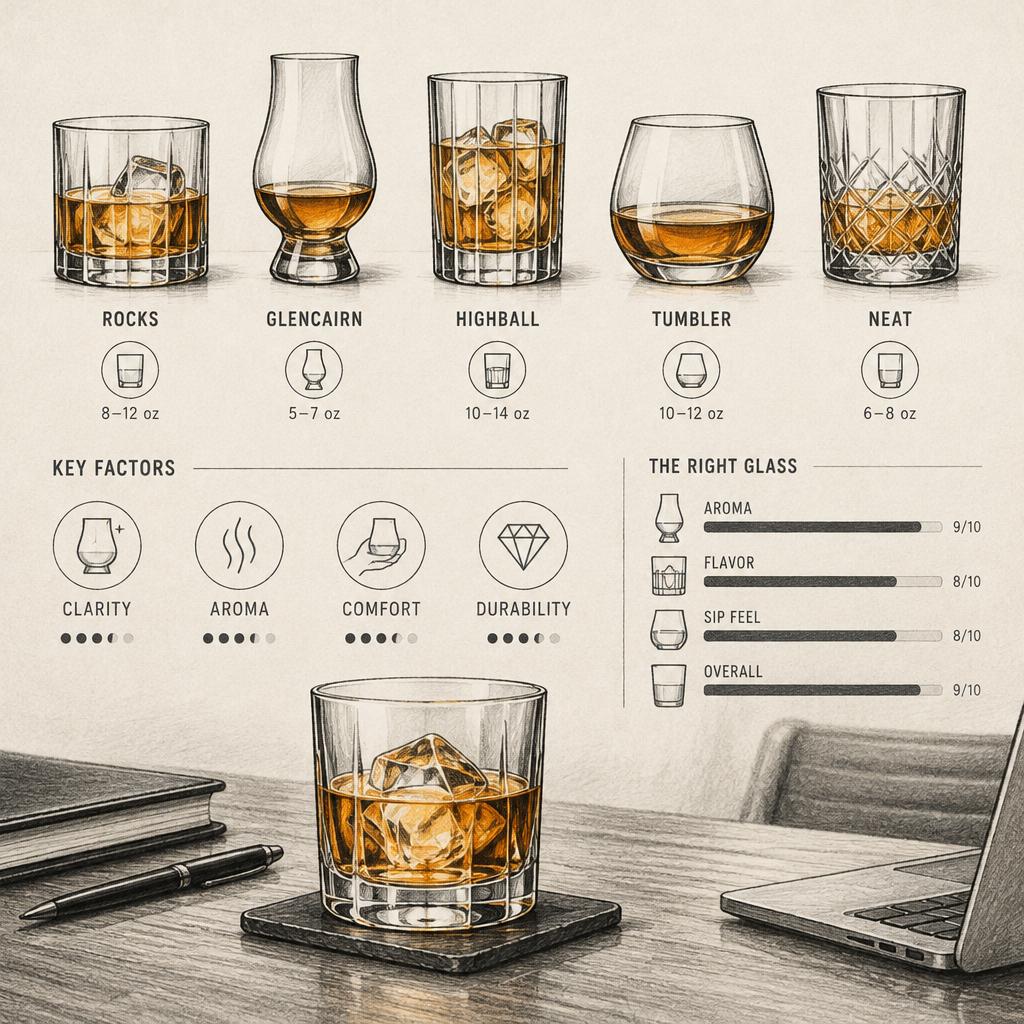
The best whiskey glasses for bourbon tasting are shaped to concentrate aroma, while the best glasses for everyday sipping are shaped to hold ice and feel stable in the hand. These are two different design goals, and one glass cannot do both without compromise.
Three shapes cover nearly every use case:
- The rocks glass or tumbler. Short, wide, heavy bottomed. Built for ice, built for grip, built for a table where people are talking more than analyzing.
- The nosing glass. Narrow rim, tulip bowl. Concentrates volatile compounds so the nose reaches them before the palate does.
- The double old fashioned. A larger rocks glass, typically holding more volume, for a bigger pour or a large ice cube.
Nosing vs. Rocks: Matching Glass to Pour
Match the glass to the pour, not the bottle's price tag. A heavy base rocks glass suits bourbon on the rocks, a cocktail, or a long conversation where the whiskey is a companion rather than the subject. A nosing glass suits deliberate tasting of a single malt or limited-release bourbon.
A useful rule: if you are adding anything to the glass, use a rocks glass. Ice, water, or a cocktail ingredient change the aroma profile, and a narrow nosing rim then traps diluted vapors.
Weighted Bases, Stability, and Ice Sphere Sizing
A weighted base is functional, not cosmetic, and the reason is thermodynamics. Glass is a poor heat conductor, and a thick slab at the bottom acts as a thermal buffer between your palm and the whiskey. Cradling a heavy base forces your hand's heat to travel through roughly a quarter inch of glass before reaching the liquid; on a thin-walled tumbler, that heat crosses a millimeter or two and warms the pour within minutes.
The second mechanism is mechanical. Mass at the bottom lowers the center of gravity, so the glass resists tipping when someone gestures mid-sentence. A 12-ounce tumbler with a genuinely thick base feels planted in a way a thin-walled rocks glass never does, and that stability nudges your grip downward, keeping your palm off the bowl.
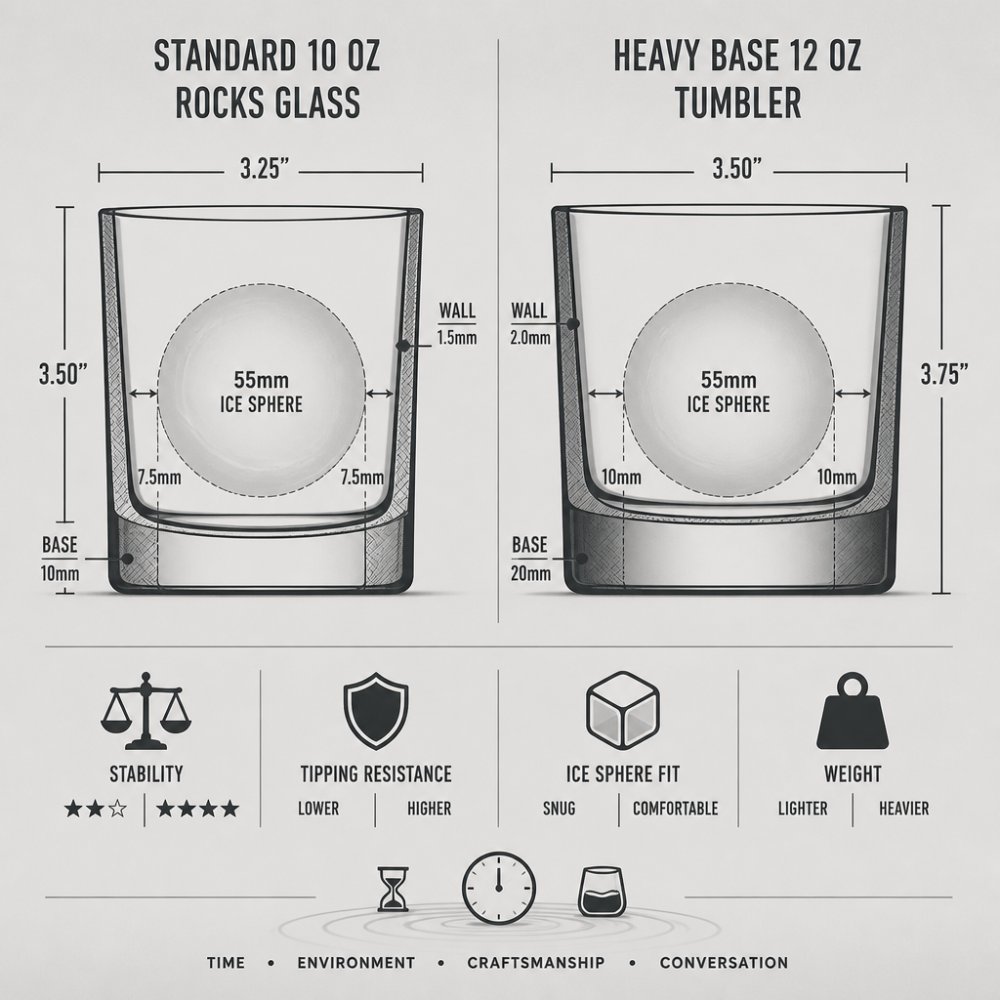
Why Ice Spheres Need Clearance, Not Just Capacity
Ice sphere sizing is where most buyers get caught out, because capacity in ounces tells you almost nothing about whether a sphere will fit. A large sphere melts more slowly than cubed ice thanks to less surface area per unit of volume, meaning less dilution over the life of the drink. But a sphere sits in a cylindrical well, and the number that matters is the interior diameter at the widest point, not the outer width, and not the stated capacity.
Here is the measurement method that works. Take the interior diameter in millimeters where the sphere would rest, then subtract the sphere's diameter. A standard large-format ice sphere runs about 55mm across. At 60mm interior diameter you have 5mm of clearance, enough for the sphere to seat below the rim with room for whiskey to move around it. At 55mm or less, the sphere perches above the rim, melts fast, and splashes every time you lift the glass.
| Interior Diameter | Ice Format That Fits | What Happens |
|---|---|---|
| Under 60mm | Standard cubes or a 1.75-inch cube | Sphere perches above the rim and splashes |
| 60-65mm | Small sphere or large cube | Sphere seats but leaves little room for liquid |
| 65mm and up | Full-size 55mm sphere | Sphere seats below the rim with headspace to spare |
A 12-ounce capacity is the practical sweet spot for a heavy base tumbler, but only when the interior diameter clears 65mm. That combination, a full sphere, a generous pour, and headspace for aroma, separates a glass built for large-format ice from one that merely claims to be.
Cleaning and Care for Weighted Crystal
Hand washing is the correct method for any weighted crystal glass. Dishwasher detergent is alkaline and abrasive, and repeated cycles etch the surface, dull clarity, and cloud the base where water pools. Drying-cycle heat also stresses the thick-to-thin transition where the base meets the bowl.
A workable routine:
- Wash in warm water with a small amount of mild dish soap and a soft sponge.
- Rinse with warm water, never hot, to avoid thermal shock.
- Dry immediately with a lint-free cloth rather than air drying, which leaves mineral spots.
- Store upright with a small gap between glasses so rims do not chip against each other.
For hard water, a periodic soak in diluted white vinegar removes mineral film without abrasion. Avoid anything labeled "scratch-free" abrasive, on crystal, it is not.
What most care guides miss is the base. The weighted bottom is the thickest part of the glass and the slowest to dry, and trapped moisture between stacked glasses causes the cloudy ring that never comes out.
Buying Heavy Base Whiskey Glasses Online: What to Check
Buying glassware online removes the one thing that matters most: the feel in your hand. That makes the spec list your substitute for picking the glass up, and the trick is knowing which specs are real signals and which are marketing language.
Reading the Spec Sheet Like a Buyer, Not a Browser
- Stated capacity in ounces. A 12-ounce capacity is versatile; anything under 10 ounces limits ice options. But capacity alone is not enough, pair it with the interior diameter below.
- Interior diameter in millimeters. This is the spec that determines whether a large-format ice sphere will actually fit. If the listing does not publish it, ask before you order. A thick base and thick walls can eat a half-inch of usable interior.
- Lead-free confirmation. It should be stated explicitly, not implied by the word "crystal." Lead-free crystal is formulated with alternative metal oxides such as barium or zinc in place of lead oxide, and the distinction matters for drinkware you use nightly.
- Base weight or thickness. If the listing does not mention it, the base is probably decorative. A genuinely weighted base is a spec the maker is proud of and will publish.
- Rim finish. A fire-polished rim is smooth; a cut rim can feel sharp. This is the difference between a glass you reach for daily and one that sits in the cabinet.
- Set size and packaging. If it is a gift, gift-ready packaging saves a step and protects the glasses in transit.
- Return policy. Glass ships fragile. A clear return window matters more here than in most categories.
The Physics Question Most Listings Never Answer
The spec sheet rarely tells you how the glass will perform, so it helps to understand the mechanism behind the numbers. Base thickness affects heat transfer from your hand, a thicker base means a slower warm-up, which matters most for neat drinkers. Wall thickness affects how quickly the whiskey reaches room temperature. Interior diameter affects whether your preferred ice format fits. Rim thickness affects how the liquid enters your mouth and how aroma escapes. None of these are cosmetic; they are the engineering of the drinking experience.
A useful test before you buy: hold a candidate glass against a white napkin under daylight. Lead-free crystal shows a faint bluish-white edge rather than a gray or green cast, two seconds that tell you more than any product photo.
Design That Ages Well
The question worth asking is whether the glass will still look right in five years. Vertical fluting, a classic short-wide profile, and a clean silhouette age well. Novelty shapes and heavy branding do not. That is the design logic behind The Pour collection: a traditional old-fashioned profile with the brand's signature logo and an etched tagline on the bottom, where it is discovered rather than announced.
That etched base detail is also the answer to whether a glass is a genuine conversation piece or just a logo. A mark on the underside rewards the person who turns the glass over, exactly the small moment that starts a better discussion in a boardroom.
Frequently Asked Questions
What makes a whiskey glass 'heavy base' or weighted?
A heavy base whiskey glass has extra glass mass molded into the bottom, usually 15 to 25 millimeters thick compared with 5 to 8 millimeters on a standard tumbler. That added weight lowers the center of gravity, so the glass sits steady on a table or bar cart and feels substantial in hand. Many weighted designs also use lead-free crystal, which adds density without the health concerns tied to leaded crystal.
How do I choose the right crystal glassware for bourbon?
Start with the pour. For neat bourbon or single malt, a short, wide rocks glass with a heavy base lets you swirl and release aroma without splashing. For nosing, a tulip-shaped glass concentrates vapors. Check the capacity (10 to 12 ounces works for most pours with a large cube), confirm the glass is lead-free, and look for vertical fluting or a fluted design if grip matters. Weight should feel balanced, not top-heavy.
How long does opened bourbon last once the bottle is open?
Opened bourbon does not spoil, but it does change. Once air enters the bottle, oxidation slowly softens the aromatics and can flatten the flavor over months. Stored upright in a cool, dark cabinet, most opened bourbon holds its character for six to twelve months; bottles under a quarter full fade faster. Transferring the last few ounces to a smaller bottle reduces headspace and slows the process.
Why does the weight of a whiskey glass matter for a tasting experience?
Weight affects how the glass feels and how steady it stays. A weighted bottom keeps the tumbler from tipping when you set it down mid-conversation, and the heft signals craftsmanship the moment someone picks it up. That tactile cue shapes the ritual: slower sipping, more attention to aroma, and a natural pause that supports longer, more focused discussions around the table.