 blog
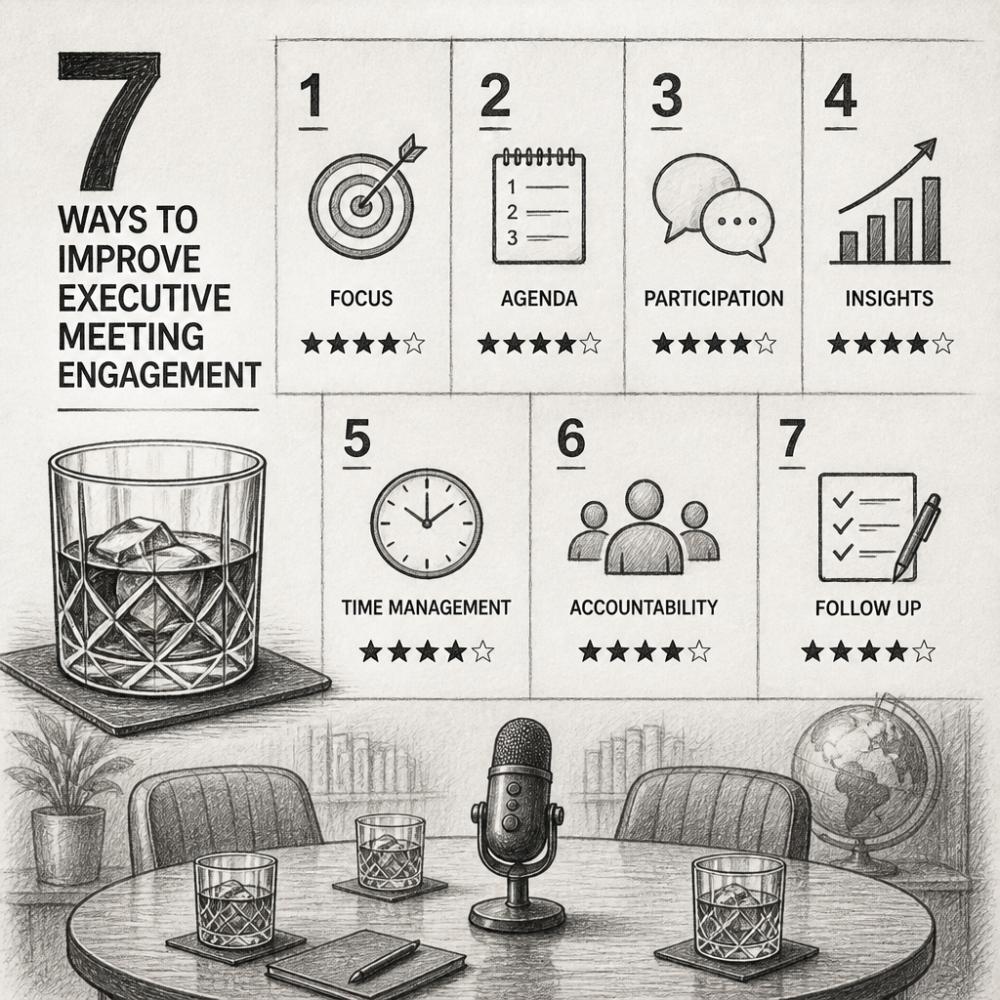
7 Ways to Improve Executive Meeting Engagement
Table of Contents
- 1. Set a Clear Meeting Agenda and Purpose
- 2. Master Boardroom Communication Best Practices
- 3. Limit Participant Count and Clarify Roles
- 4. Determine Effective Meeting Duration for Executives
- 5. Build Psychological Safety Into Executive Discussions
- 6. Use Tools for Executive Meeting Productivity
- 7. Create Accountability Through Post-Meeting Tracking
- Frequently Asked Questions
Last Updated: September 18, 2026
1. Set a Clear Meeting Agenda and Purpose
A strong meeting agenda is the foundation of executive meeting engagement. Without one, participants arrive unprepared and conversations drift. The agenda tells people what to expect, why they're there, and what decisions need to happen.
The best agendas include three elements: the topic, the time allotted, and the desired outcome. Assign 10-15 minutes per agenda item for typical executive meetings. Be specific about what "decision" or "discussion" means, vague language wastes time.
Share the agenda at least 24 hours before the meeting. This gives attendees time to review materials and come mentally prepared. When people know the purpose upfront, they engage differently. They ask better questions. They challenge assumptions more thoughtfully.
Meetings with clear agendas often run shorter because participants stay focused. A written agenda also creates accountability, you can reference it if the conversation veers off track.
2. Master Boardroom Communication Best Practices
Executive communication demands precision and respect for time. Every word matters. Every pause carries weight.
Boardroom communication best practices start with active listening. This means listening to understand, not listening while planning your response. When an executive finishes speaking, pause for two seconds before responding. This small gap signals that you absorbed what they said.
Avoid interrupting. In fast-paced executive environments, interruptions feel like momentum. They're actually conversation killers. Let people finish their thoughts completely. If someone is unclear, ask clarifying questions instead of filling in gaps yourself.
Use data to support opinions. Executives respect evidence. If you're recommending a direction, bring numbers. Show the research. Cite the source. This separates informed recommendations from guesses.
Keep statements concise. Executives process information quickly. A 30-second explanation beats a 3-minute one. If someone asks for more detail, provide it. But start tight.
One often-overlooked practice: acknowledge what others have said before adding your perspective. "That's a solid point about timeline. Here's what I'd add on budget." This technique builds psychological safety and shows you're building on ideas, not dismissing them.
3. Limit Participant Count and Clarify Roles
Too many people in an executive meeting kills engagement. Each additional person dilutes accountability and slows decision-making.
The ideal size depends on the meeting type. For strategic decisions, keep it to 5-7 people. For status updates, 3-4 is often enough. For brainstorming, 6-8 works well. Anything over 10 becomes a presentation, not a discussion.
Before sending the invite, ask: Does this person need to decide? Do they need to implement? Do they need to know the outcome? If the answer is "no" to all three, they shouldn't attend.
Clarify roles at the start. Who's the decision-maker? Who's providing input? Who's taking notes? Who's watching the time? Unclear roles create confusion. People either sit silent or everyone talks at once.
Assign someone to track action items in real-time. This person doesn't participate in discussion, they listen and document. This role prevents important decisions from getting lost in conversation.
Consider rotating who facilitates. This spreads leadership responsibility and keeps meetings fresh. Different facilitators bring different energy to discussions.
4. Determine Effective Meeting Duration for Executives
Effective meeting duration for executives isn't about clock time, it's about focus time. Executives operate with limited bandwidth. Meetings that respect that reality get better engagement.
Most strategic executive meetings should run 45-60 minutes. This window is long enough for real discussion but short enough to maintain attention. Anything over 90 minutes loses momentum.
Status update meetings should be 20-30 minutes. If it's taking longer, you're not being concise enough with updates, or you're mixing in discussions that need their own meeting.
Time-box each agenda item. If item one gets 15 minutes, stick to it. When time runs out, decide: table it, extend by 5 minutes, or schedule a follow-up. Don't let one topic consume the whole meeting.
Build in a 10-minute buffer at the end. Real discussions sometimes need more time. A buffer prevents you from cutting off important conversation or running over and making the next meeting late.
Start on time. End on time. This discipline signals respect for people's calendars. Executives notice when meetings honor time commitments.
Avoid scheduling meetings back-to-back. Executives need transition time between meetings to process what happened and prepare for what's next. A 15-minute gap between meetings improves engagement in both.
5. Build Psychological Safety Into Executive Discussions
Psychological safety is the belief that you can take interpersonal risks in a meeting without fear of embarrassment or punishment. In executive settings, it's rare and powerful.
Without psychological safety, executives hold back. They don't voice concerns. They don't challenge weak ideas. They perform instead of thinking.
Create safety by responding well to questions. When someone asks a question, treat it as curiosity, not criticism. Answer directly. Don't get defensive.
Admit what you don't know. If an executive says "I'm not sure about that," other executives relax. Permission to be uncertain ripples through the room.
Disagree respectfully and often. If everyone agrees, someone isn't thinking hard enough. Healthy executive meetings have tension. The tension should be about ideas, not personalities.
Avoid public criticism of someone's idea. If an idea is weak, discuss it in the moment, but frame it around the idea itself: "I see the logic, but here's where the data doesn't support it." Not: "That's not a strong suggestion."
Reference past successes that came from new ideas. Tell stories about times someone's unconventional thinking led to good outcomes. This history signals that risk-taking is valued.
6. Use Tools for Executive Meeting Productivity
The right tools eliminate friction. They keep meetings on track and preserve information.
A shared document for notes keeps everyone aligned. Assign someone to capture decisions and action items in real-time. Share the document before the meeting ends. This prevents the "what did we decide?" confusion that happens later.
Video conferencing platforms with screen-sharing enable hybrid meetings where remote participants feel included. Look for platforms that show multiple video feeds clearly, not just the speaker.
A simple timer visible to everyone helps time-box agenda items. Many video platforms have built-in timers. Use them.
A digital whiteboard works well for brainstorming sessions. Tools let multiple people add ideas simultaneously, then organize them together. This beats talking while one person types.
A meeting scheduling tool that shows everyone's calendar prevents the back-and-forth on timing. It respects people's time and reduces friction.
Avoid tools that create more work. If the tool requires 10 minutes of setup before each meeting, people will skip it. Simple and fast wins.
The best tool is often the one your team already uses. Adoption matters more than features.
7. Create Accountability Through Post-Meeting Tracking
Post-meeting accountability separates meetings that matter from meetings that were just talk.
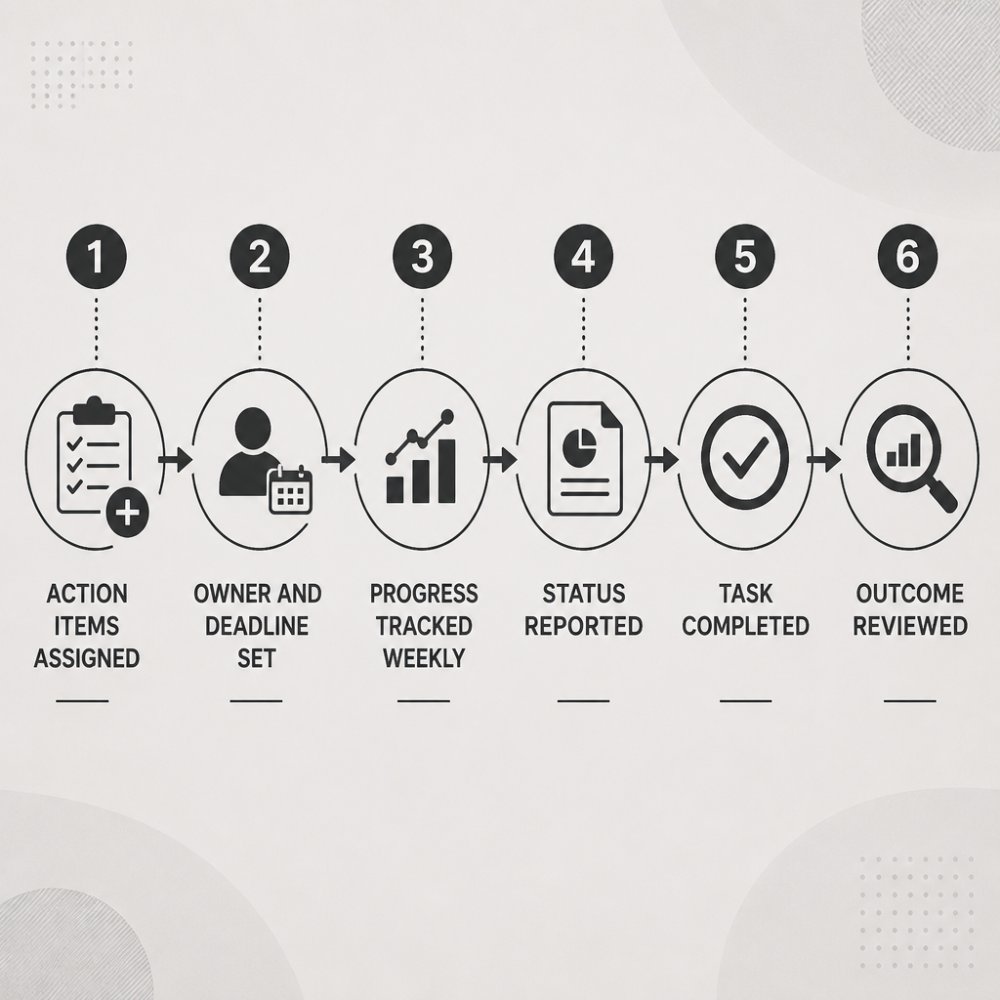
Document every action item with three details: what needs to happen, who owns it, and when it's due. Vague action items don't get done.
Send the action item list within one hour of the meeting. Include the decisions made. Include what didn't get decided and why. This creates a record.
Schedule a brief follow-up check-in one week later. This isn't a full meeting, it's a 15-minute sync to confirm action items are on track. If something is stuck, unblock it immediately.
Assign one person to own the tracking. This person sends reminders, flags delays, and reports progress. Without an owner, tracking falls apart.
Review completed action items at the next relevant meeting. Did the action produce the expected result? Was the deadline realistic? This feedback improves future meetings.
Track which action items actually get done. If 40% of your action items are abandoned, something is wrong.
Frequently Asked Questions
How can leaders foster psychological safety in executive meetings?
Psychological safety in executive meetings begins with the leader modeling vulnerability by admitting mistakes and inviting dissenting opinions without defensiveness. Establish a norm where questions and pushback are expected, not punished. Use phrases like 'I might be wrong about this' and actively solicit input from quieter participants. When someone speaks up with a contrarian view, thank them explicitly. This transforms the meeting culture from one where executives perform confidence into one where they collaborate openly, leading to better decisions and higher engagement.
What's the ideal meeting duration for executive teams?
Most executive meetings function best at 45 minutes or less. Longer sessions create meeting fatigue and dilute focus, especially when decision-makers have competing priorities. Time-boxed agendas force clarity: 10 minutes for context, 25 minutes for discussion, 10 minutes for decision and next steps. For strategic discussions requiring deeper exploration, two 45-minute sessions spaced a day apart outperform a single 90-minute meeting. The key is respecting executive time as finite and protecting it fiercely, which signals that the meeting itself must deliver proportional value.
How do you track accountability after executive meetings end?
Assign each action item to a specific owner with a concrete deadline before the meeting closes. Within 24 hours, send a written summary listing who owns what and when it's due. Schedule a brief 15-minute check-in one week later to review progress on high-priority items. For ongoing initiatives, build a simple tracking document (shared spreadsheet or project tool) where owners update status weekly. This asynchronous accountability mechanism keeps momentum without requiring another full meeting, and it demonstrates that decisions made in the boardroom actually drive workflow outcomes.
What role does the physical environment play in executive meeting engagement?
The boardroom itself shapes how executives show up. A space with clear sightlines, comfortable seating, and minimal distractions reduces meeting fatigue and supports active listening. Thoughtful details, like quality glassware, proper lighting, and temperature control, signal respect for participants' time and create a setting where serious conversation feels natural. Removing phones from the table and ensuring everyone can see and hear each other without strain removes friction that otherwise fragments attention. The environment reinforces meeting culture: a refined, intentional space tells leaders this is where decisions that matter happen.