 listicle
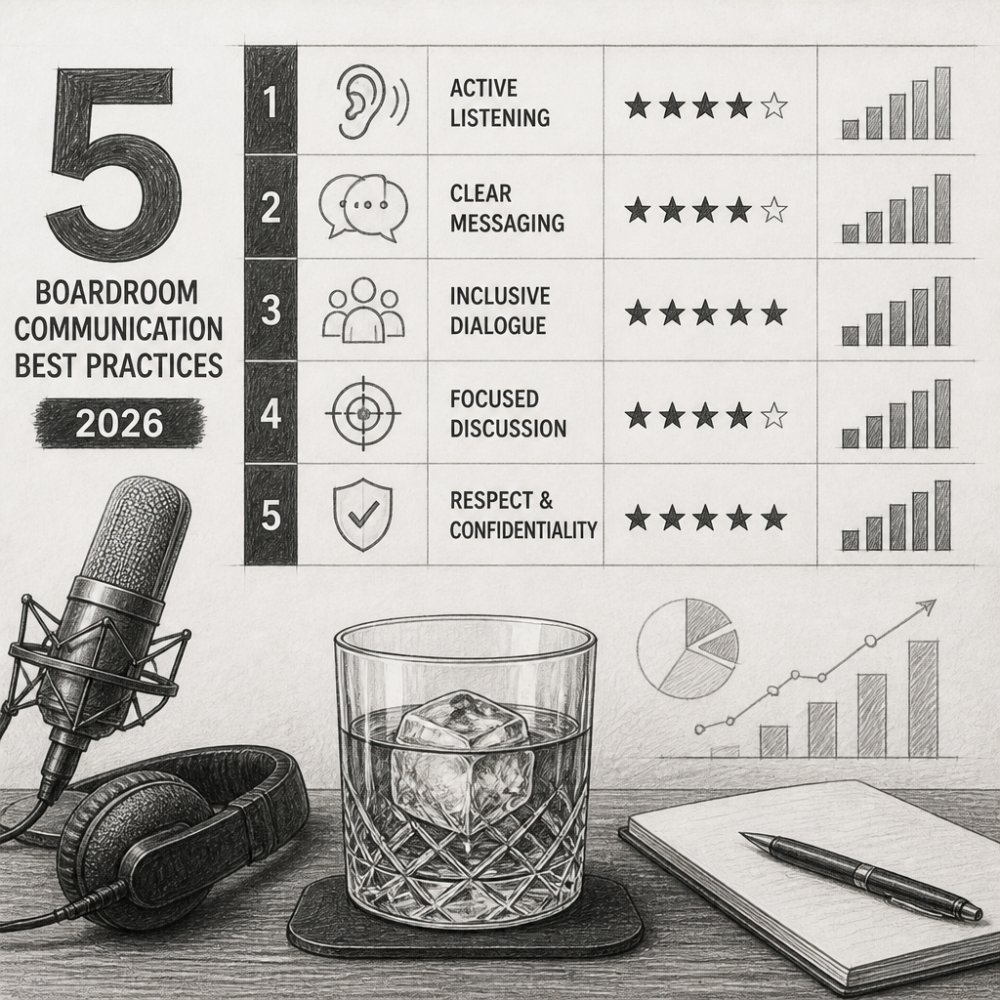
5 Boardroom Communication Best Practices for 2026
Table of Contents
- Why Boardroom Communication Needs a Reset in 2026
- 1. Standardize Reporting with Board Meeting Communication Templates
- 2. Master Boardroom Meeting Duration Best Practices
- 3. Build a Cadence for Between-Meeting Dialogue
- 4. Apply Executive Boardroom Etiquette to Every Interaction
- 5. Secure Your Boardroom Communication with Digital Protocols
- Which Practice Will You Implement First?
- Frequently Asked Questions
Last Updated: September 9, 2026
Why Boardroom Communication Needs a Reset in 2026
Boardroom communication is the structured exchange of information between a company's board of directors and its executive leadership, designed to support strategic oversight and informed decision-making. The traditional model of quarterly meetings and dense slide decks no longer serves modern governance, where boards face compressed timelines, greater regulatory scrutiny, and a persistent information gap with management.
The five practices below matter because they address the friction points most governance teams feel but rarely name. Poor preparation, marathon meetings, and silence between sessions create what governance experts call information asymmetry, where executives hold more context than directors can reasonably absorb. The result is reactive oversight instead of genuine strategic partnership. These practices fix that imbalance.
Below, we outline the specific protocols that separate functional boards from exceptional ones. Each practice is actionable this quarter, not theoretical.
1. Standardize Reporting with Board Meeting Communication Templates
Board meeting communication templates are the single highest-use tool for improving boardroom communication in 2026. A standardized template forces discipline: it compresses the most material topics into a consistent format that directors can scan quickly and compare across quarters.
A common approach is the executive summary model. The CEO and CFO submit a two-page brief covering financial performance, key risks, and decisions requiring board input, followed by a KPI dashboard with no more than ten metrics. Supporting detail lives in appendices, not the main deck. This structure respects director time and makes the board package genuinely useful.
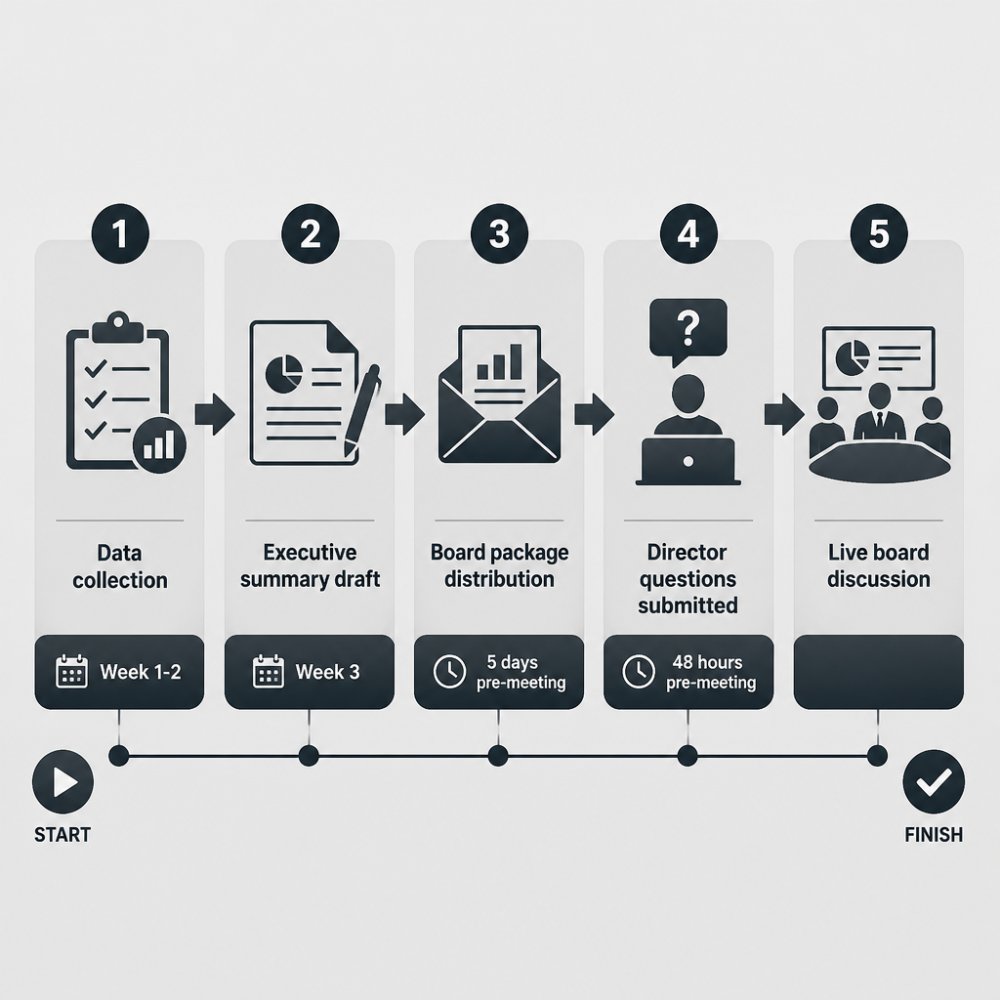
The flow matters as much as the format. Data collection happens in the two weeks before distribution, the executive team drafts the summary, and the full board package lands in directors' hands at least five business days before the meeting. That window allows directors to flag concerns in writing, so the live session focuses on discussion rather than first impressions.
2. Master Boardroom Meeting Duration Best Practices
Boardroom meeting duration best practices have shifted decisively toward shorter, more frequent sessions. The era of the six-hour quarterly marathon is ending, replaced by a two-hour focused meeting that assumes directors arrived prepared.
A practical structure is ninety minutes for strategic discussion, thirty minutes for consent agenda items, and a hard stop at two hours. The consent agenda, which bundles routine approvals like prior meeting minutes and standard financial reports, clears administrative noise in the first ten minutes. This preserves the remaining time for the discussions that actually require collective judgment.
Meeting efficiency improves when the chair enforces timeboxes per agenda item. If a topic needs more than twenty minutes, it likely requires a dedicated working session rather than a full-board discussion. This discipline respects the fiduciary duty directors hold and models respect for their limited availability.
3. Build a Cadence for Between-Meeting Dialogue
The between-meeting cadence is where boardroom communication either thrives or dies. Quarterly contact is insufficient for meaningful strategic oversight, particularly when market conditions shift rapidly.
A common approach is a monthly written update from the CEO, limited to one page, covering wins, risks, and one question for the board. This is not a meeting and it is not a report; it is an asynchronous communication workflow that keeps directors oriented without demanding their calendar. Some boards add a quarterly informal call between the chair and each director to surface concerns that never make it into formal channels.
This cadence builds trust gradually. Directors who receive consistent, honest updates between meetings ask sharper questions during formal sessions. Executives who share bad news early, rather than waiting for the quarterly reveal, earn credibility that pays dividends during difficult decisions. The goal is a two-way dialogue where information flows in both directions, not a one-way broadcast from management.
4. Apply Executive Boardroom Etiquette to Every Interaction
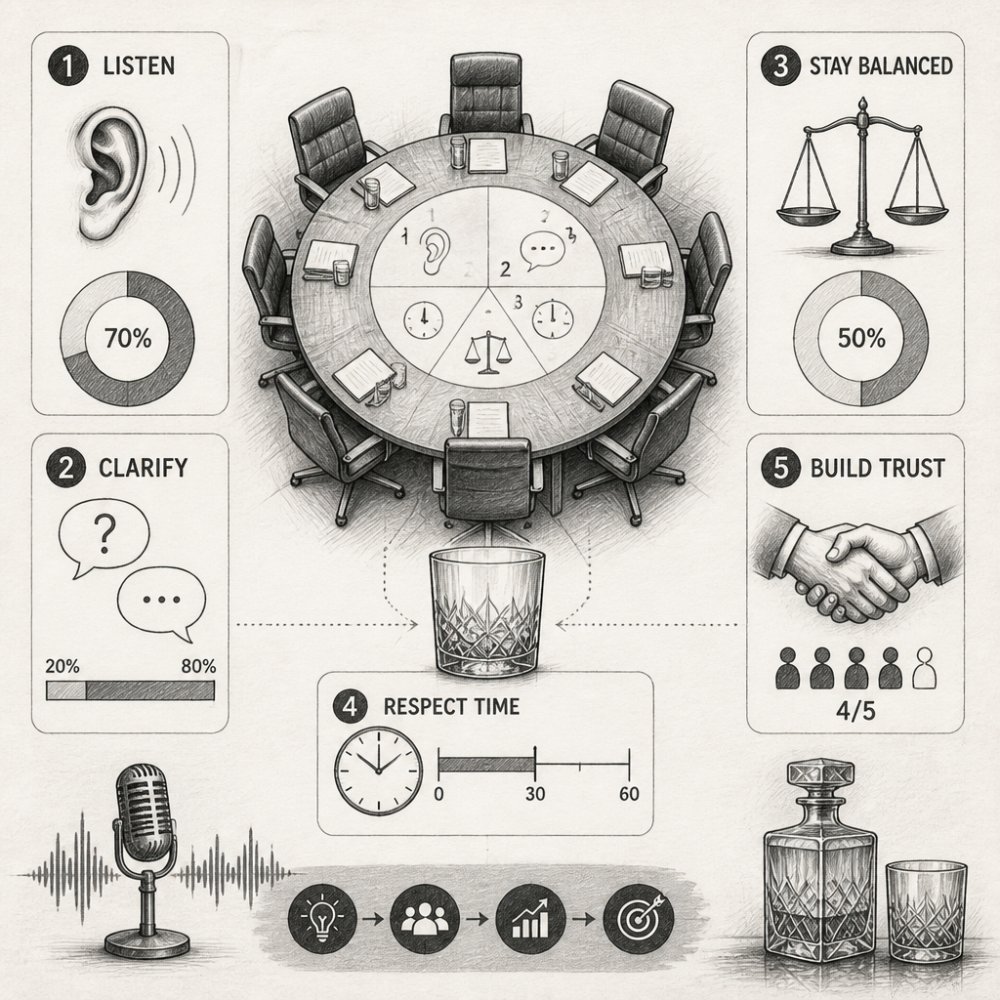
Executive boardroom etiquette governs the unspoken rules that determine whether a board functions as a team or as a collection of individuals protecting their reputations. The fundamentals include arriving prepared, listening before speaking, and challenging ideas rather than people.
Constructive feedback is the core skill. Directors should frame questions to elicit information, not to demonstrate their own expertise. A question like "What assumptions underpin this forecast?" opens dialogue, while a statement like "This forecast is wrong" shuts it down. The chair bears responsibility for modeling this behavior and gently redirecting directors who drift into monologues.
Confidentiality underpins every other etiquette rule. Board discussions involve material topics that, if leaked, could affect share prices, employee morale, or competitive position. Directors who breach confidentiality destroy trust irreparably and expose the company to regulatory and legal risk. This expectation should be stated explicitly in the board charter and reinforced annually.
Transparency has a boundary, and etiquette defines it. Directors are entitled to full information for decision-making, but executives retain the right to discuss sensitive personnel matters and pending negotiations in closed session. Respecting that boundary prevents the awkwardness that arises when information is shared inappropriately.
5. Secure Your Boardroom Communication with Digital Protocols
Digital security is the blind spot in most boardroom communication strategies. Boards now review materials on personal devices, share files through consumer platforms, and communicate via text message, creating exposure that most executive teams have not fully assessed. In 2026, this is not just an IT concern; it is a governance and fiduciary duty issue. A data leak from a board member's personal device can trigger regulatory scrutiny, reputational damage, and legal liability that dwarfs the cost of prevention.
The threat landscape has shifted. Phishing attacks targeting directors have become more sophisticated, often using publicly available information about board activities to craft convincing lures. Personal email accounts are a common entry point, and once compromised, they can expose sensitive board materials forwarded for convenience. The risk is not hypothetical; it is a leading cause of board-related data breaches.
A common approach is adopting a dedicated board portal that provides secure document storage, access controls, and audit trails. These platforms allow the board package to be revoked remotely if a director's device is lost or compromised. For boards not ready for a portal, the minimum standard is encrypted email for sensitive materials and a clear policy prohibiting the forwarding of board documents to personal accounts.
Beyond the tools, the protocol is what matters. A robust digital communication policy should address:
- Device management: Require multi-factor authentication on all devices used to access board materials. Consider a policy that board-issued devices are used for board business only.
- Data classification: Clearly label materials as 'Confidential' or 'Board Confidential' so directors understand the handling requirements.
- Incident response: Define a clear chain of command for reporting a suspected breach. The first call should be to the board chair and legal counsel, not to IT support. Time is of the essence in containing a leak.
- Annual training: A brief, annual refresher on phishing and social engineering tactics is a low-cost, high-impact control. Directors are busy, but a 15-minute module is a reasonable expectation.
Crisis communication protocols deserve specific attention. When a material event occurs, the board needs a predefined chain for notification: the CEO contacts the chair immediately, the chair determines whether a full-board call is warranted, and legal counsel participates from the first discussion. Agreeing on this protocol in calm times prevents chaotic, uncoordinated responses when it matters most.
Which Practice Will You Implement First?
No board adopts all five practices in a single quarter. The recommendation is to start with standardized reporting templates, because they create the foundation that makes every other practice easier. Shorter meetings require better preparation. Better preparation requires a consistent cadence. A consistent cadence builds the trust that makes etiquette and security protocols feel like shared values rather than imposed rules.
The tangible ritual of gathering matters too. Whether it is a working dinner after a long session or a deliberate pause before a difficult vote, the physical setting shapes the quality of conversation. Bourbon in the boardroom designed The Pour collection for precisely these moments: a weighted, short-wide old-fashioned glass with an etched tagline on the bottom that surfaces only when the glass is empty. It is a quiet reminder that the best boardroom communication ends with clarity, not just consensus.
Boardroom communication in 2026 demands more than polished slides and punctual attendance. It requires deliberate systems for preparation, disciplined time management, and a culture where candor is safe and confidentiality is absolute. Bourbon in the boardroom supports leaders who treat these gatherings as the strategic asset they are. The Pour collection, with its classic design and conversation-starting details, makes a fitting centerpiece for the discussions that shape your company's future. Add to cart
Frequently Asked Questions
What are the 5 C's of effective boardroom communication?
The 5 C's are clarity, conciseness, consistency, candor, and confidentiality. Clarity means avoiding jargon and using plain language. Conciseness respects the board's time, a core part of boardroom meeting duration best practices. Consistency comes from using board meeting communication templates. Candor is the ability to deliver honest, constructive feedback. Confidentiality ensures sensitive information remains protected, which is a cornerstone of executive boardroom etiquette.
How has boardroom communication evolved for 2026?
Boardroom communication in 2026 relies less on static presentations and more on asynchronous workflows and data-driven insights. Boards now expect a two-way dialogue between meetings, not just formal sessions. AI-assisted reporting tools help distill material topics into executive summaries for the board package. Digital security is also a central concern, with protocols for handling sensitive information becoming as important as the communication itself.
What are the most effective communication skills for board members?
The most effective skills are active listening, strategic questioning, and disciplined candor. Members who listen before speaking foster a culture of transparency. Strategic questioning moves the discussion from operational details to strategic oversight and risk management. Disciplined candor involves raising concerns about fiduciary duty or succession planning directly, but with respect. These skills support meeting efficiency and stronger board-executive relationships.
How do board meeting communication templates improve governance?
Templates standardize the board package, ensuring every member receives the same briefing materials in the same format. This reduces information asymmetry and prevents critical data from being buried in lengthy appendices. A good template includes an executive summary, a KPI dashboard, and a consent agenda. This structure helps directors prepare effectively, leading to more productive meetings and stronger accountability across the board.