 listicle
Leadership Lessons From Bourbon: Time, Quality, Patience
Last Updated: November 4, 2026
Quick Summary
Leadership lessons from bourbon center on time, quality, and patience: a barrel cannot be rushed, and neither can trust, skill, or reputation. Set conditions, verify the actual output, and let people and initiatives reach their natural conclusion before judging them.
- Name a realistic maturation period for each new hire or initiative and put the review date on the calendar.
- Weekly status is activity while quarterly evidence is progress, so do not confuse the two.
- Define the three standards that matter most in observable terms and check your own behavior against them monthly.
- Sample the real work once a cycle instead of relying on status reports and intentions.
- Fund a new initiative from cash flow so a slow start does not become existential.
Table of Contents
- What Bourbon Teaches Leaders About Time, Quality, and Patience
- Patience in Leadership: What the Barrel Cannot Rush
- Quality and Consistency in Leadership: The Standard You Hold When No One Checks
- Long-Term Thinking in Leadership: Building for the Decade, Not the Quarter
- Leadership Lessons for Small Business Owners Who Cannot Afford a Bad Batch
- Where the Bourbon Analogy Breaks Down
- Pour One for the Conversation That Moves Your Team Forward
- Frequently Asked Questions
What Bourbon Teaches Leaders About Time, Quality, and Patience
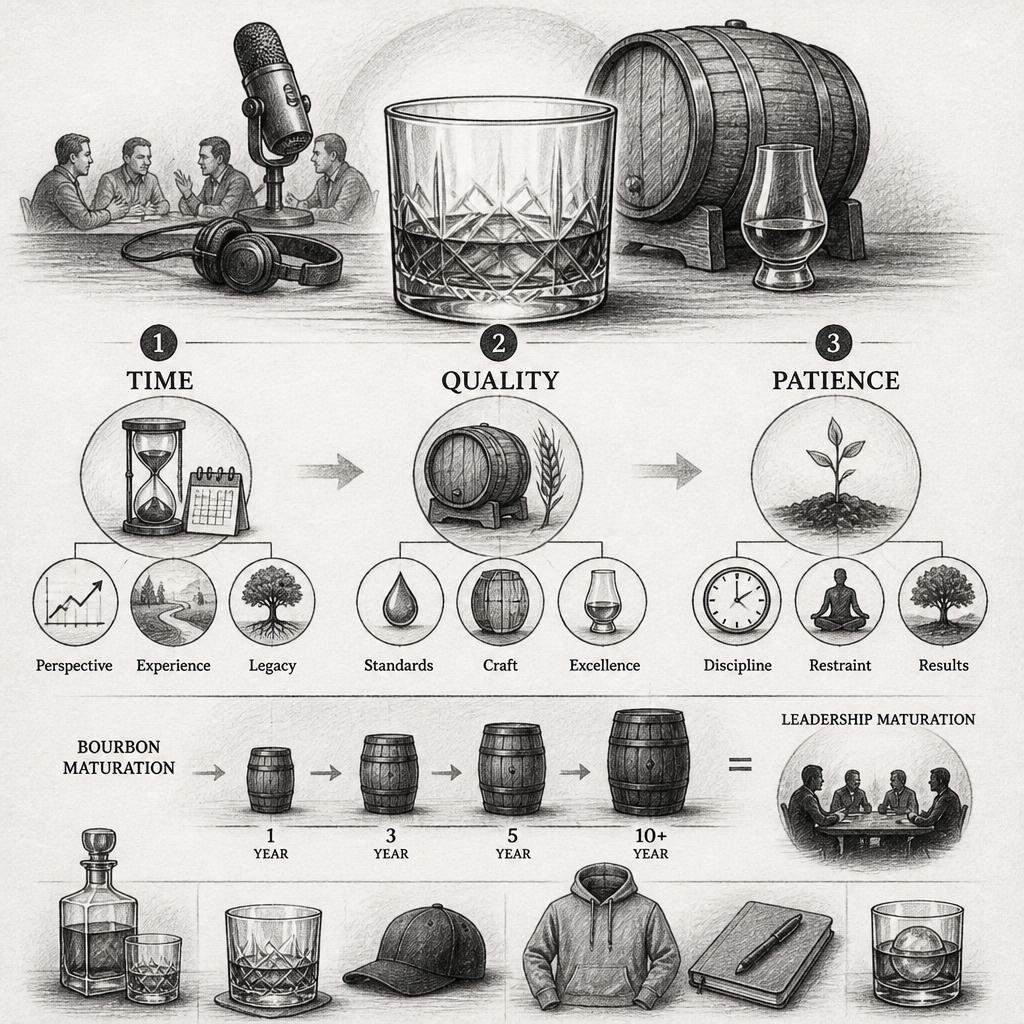
Bourbon is a slow business. A newly filled barrel sits in a rickhouse for years before anyone knows whether the whiskey inside will become something worth pouring, and no amount of pressure from the front office changes that timeline. That single fact explains why leadership lessons from bourbon keep surfacing in conversations among executives, founders, and small business owners. This guide from Bourbon in the boardroom draws on that parallel: time, quality, and patience are the shared traits of good leadership and great bourbon.
The comparison is not decorative. Distillers manage a product they cannot rush, cannot fake, and cannot fully control, which is exactly the position most leaders are in with their teams and their reputations. Below are the lessons that hold up in practice, the places where the analogy strains, and how to apply each one at work.
Patience in Leadership: What the Barrel Cannot Rush
Patience in leadership is the discipline of letting a process reach its natural conclusion instead of forcing an early result. A barrel cannot be hurried, and neither can trust, skill, or a market position built on reputation.
Leaders face the same math with people. A new hire needs months to become useful. A client relationship needs quarters to become a referral engine. Pushing for the outcome early usually damages the thing you were trying to speed up.
Treat patience as a practice with a physical anchor. A slow pour, a glass that forces the hand to settle, and a conversation that is not being timed all create the conditions for deliberate thought. Glassware built for that kind of pause gives the ritual somewhere to land.
A Practical Patience Playbook for Busy Leaders
- Name the maturation period. Write down how long a new initiative or hire realistically needs before you judge it, and put the review date on the calendar.
- Separate activity from progress. Weekly status is activity. Quarterly evidence is progress. Do not confuse the two.
- Resist the early verdict. A common mistake is declaring a strategy dead in month two when the pipeline has not had time to fill.
- Protect one long-horizon project. Keep at least one effort that will not pay off this year, and defend it from the quarterly review.
- Ask what the barrel would do. If the answer is "wait and check the conditions," wait and check the conditions.
The patience playbook boils down to a handful of concrete moves.
| Step | What to do |
|---|---|
| Name the maturation period | Write down how long a hire or initiative needs before judging it |
| Separate activity from progress | Weekly status is activity; quarterly evidence is progress |
| Resist the early verdict | Do not declare a strategy dead in month two |
| Protect one long-horizon project | Keep one effort that will not pay off this year |
| Ask what the barrel would do | If the answer is wait, wait and check conditions |
Quality and Consistency in Leadership: The Standard You Hold When No One Checks
Quality control in a distillery does not stop when the inspector leaves. The best operations hold the same standard on a Tuesday afternoon as they do on a tour day, because the product either meets the bar or it does not.
It helps to know what distillers actually control, because the metaphor is more useful when it is accurate. A distiller makes a series of quality decisions long before a barrel is filled: the grain recipe (the mash bill), the yeast strain, the distillation proof, and the barrel's char level and toast.
Make the standard explicit and repeatable. A distiller's quality bar is written down and applied the same way to every batch. Most teams never write theirs down, which is why standards drift with mood.
Verify at the point of output, not just at the point of intent. Distillers taste from the barrel, not from the plan. Leaders often review intentions in meetings and never inspect the actual output.
Hold the standard through the boring middle. Consistency is where most leaders slip. Distillers cannot afford that, and neither can a business whose reputation rests on repeatable results. What separates premium glassware from ordinary glass comes down to the same idea: weight, clarity, and craftsmanship that hold up under daily use rather than a first impression.
Connect quality to a measurable outcome. Quality-first language stays abstract until it is tied to something the business tracks: repeat purchase rate, defect or rework rate, customer complaint volume, or on-time delivery. Pick one metric that reflects your standard and review it on a fixed cadence.
Watch out: quality-first thinking can become perfectionism that delays shipping, and consistency can become rigidity when the standard itself is outdated. A distiller revisits the mash bill when the market shifts; a leader should revisit the standard on a schedule rather than only after a failure.
Long-Term Thinking in Leadership: Building for the Decade, Not the Quarter
Long-term thinking in leadership means making decisions today that a future version of the business will thank you for, even when the current quarter offers a shortcut. Aging whiskey rewards the patient operator and punishes the one who pulls barrels early to hit a number.
The tension is real. Public companies answer to quarterly earnings, and small firms answer to cash flow. Neither excuse removes the need for a long view. A useful habit is to ask, for any major decision, what it looks like in three years and in ten. Decisions that only survive the first check are usually the ones that get reversed.
That framing also changes how you invest in people. Training, mentorship, and succession planning are all barrel-time investments. They look like cost this quarter and compound value later.
Leadership Lessons for Small Business Owners Who Cannot Afford a Bad Batch
Small business owners carry a version of the distiller's risk that larger firms rarely feel. One bad batch at a small operation is not a rounding error; it is a cash crisis.
Protect the core before chasing growth. A small firm that expands faster than its quality controls can absorb is bottling a bad batch at scale.
Build redundancy into the relationships and skills that would sink you. The distiller's equivalent is never letting one barrel or one supplier determine the whole year's release.
Separate a good quarter from a durable model. One strong month is a data point, not a trend. The most common failure is treating a single strong quarter as proof of a durable model and hiring against it.
Apply the patience lesson differently than a large firm would. A public company can absorb a slow year; a small firm often cannot. Patience for a small owner does not mean waiting passively, it means sequencing.
Treat people care as a retention strategy, not a nicety. In a small team, one departure can erase months of momentum.
Watch the trade-offs. Patience can become indecision when a small owner waits for perfect information that will never arrive. Quality-first thinking can become perfectionism that delays a launch past the window. Tradition can become resistance when the market has already moved.
Why generic gifts and generic gestures fail with senior management makes a related point about standards, and the logic transfers to how a small firm presents itself to the people it wants to impress.
Where the Bourbon Analogy Breaks Down
The comparison has limits, and honest leaders should know them. A barrel cannot pivot when the market shifts. A team can, and must. A barrel has no opinion about feedback. People need it, and withholding it in the name of patience is not patience at all. Silence is not maturation.
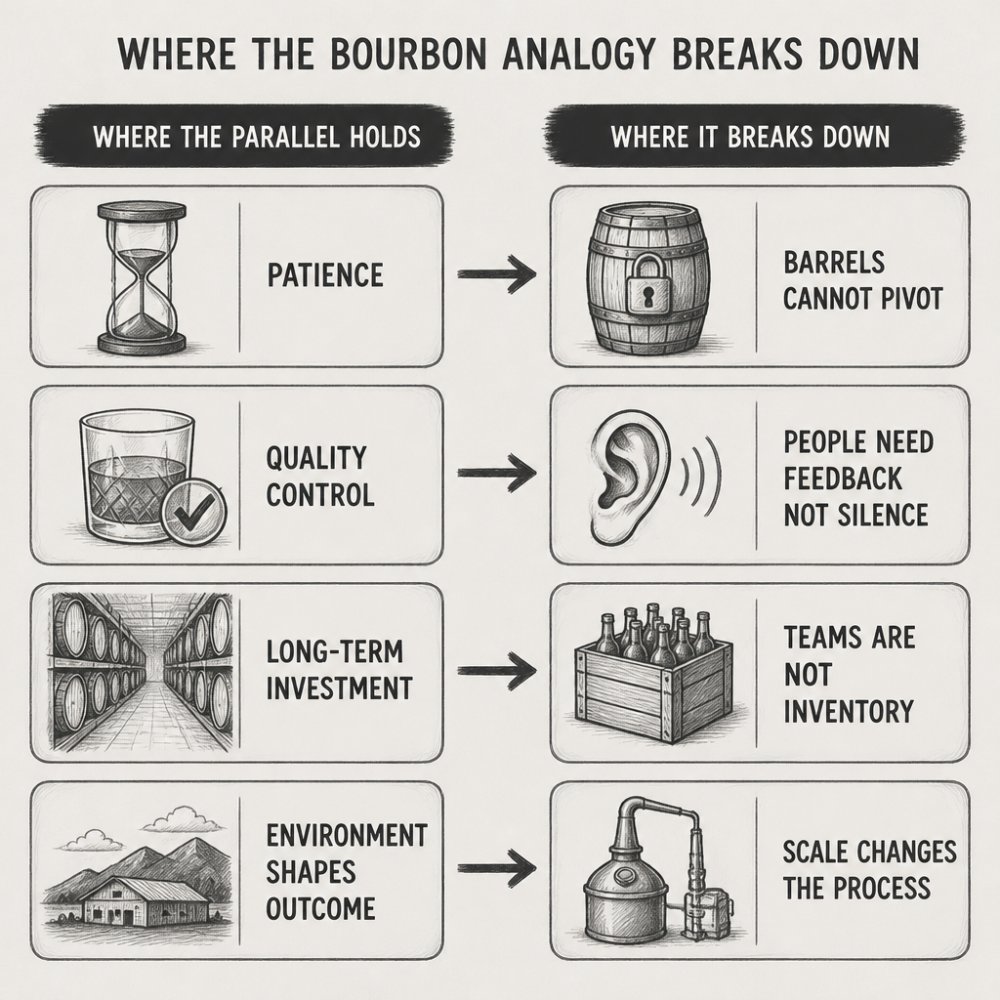
The other break is scale. A distiller's process is largely fixed once the barrel is filled. A leader's process has to change as the team grows, because what works for eight people fails at eighty. Use the bourbon frame for the values it teaches, then put it down when the situation calls for speed, candor, or a hard reset.
Pour One for the Conversation That Moves Your Team Forward
The hardest part of leadership is rarely knowing the right principle. It is holding that principle on a Wednesday when the numbers are soft and someone wants an answer by Friday. Patience, quality, and a long view all require a deliberate pause, and deliberate pauses need a place to happen.
Bourbon in the boardroom exists to make that pause easier. The Pour collection offers a classic short-wide old-fashioned glass with a weighted feel, a signature logo, and a unique etched tagline on the bottom, built as a conversation starter for the meetings that matter. If the goal is to keep this conversation going beyond one article, join the community for exclusive bourbon content, events, and membership. A leader who wants to support the mission behind the podcast can browse the shop for apparel, glassware, and gifts that fund the work.
Frequently Asked Questions
What can bourbon teach leaders about patience?
Bourbon cannot be rushed into maturity, and neither can trust or skill. A leader who demands instant results from a new hire or a new strategy is like a distiller pulling barrels early: the product looks finished but lacks depth. Practically, that means setting review points at 90 days and 12 months instead of weekly, and asking what is maturing rather than only what shipped. Patience in leadership is not slowness; it is the discipline to let a process finish before judging it.
How does the bourbon-making process relate to quality and consistency in leadership?
Bourbon is judged on whether a bottle tastes the same year after year, which requires controlled ingredients, controlled environment, and controlled time. Teams judge leaders the same way. Quality and consistency in leadership means your one-on-ones happen on schedule, your standards survive a bad week, and your decisions follow stated values rather than mood. The lesson is that consistency is a process decision, not a personality trait, so write the process down and audit it.
How can leadership lessons for small business owners differ from large-company advice?
A small business owner is often the entire quality-control department, so one rushed decision can spoil the whole batch. Leadership lessons for small business owners should focus on what a single person can actually sustain: fewer priorities, documented processes, and a short list of non-negotiables. Where a large company can absorb a bad hire or a weak quarter, a small team feels it immediately. The bourbon parallel is a craft distillery, where the owner tastes every barrel.
How can leaders build trust over time and practice long-term thinking in leadership?
Trust compounds the way flavor does: slowly, through repeated exposure to the same standard. Long-term thinking in leadership means making decisions you can defend in five years, investing in people before you need them, and resisting the quarterly shortcut that trades reputation for a number. One concrete habit is a standing ten-year question in planning meetings: what does this decision look like to the person who inherits it? Keep a written record of promises and close them.
The next hard decision on the calendar will not wait for perfect information, and neither does a barrel. Bourbon in the boardroom gives leaders a tangible way to slow the room down: weighted old-fashioned glasses, a signature logo, and an etched tagline on the bottom that starts the kind of conversation worth having. Get started with Bourbon in the boardroom and turn the next hard discussion into one your team remembers.