 how-to
Does Physical Weight Affect Perceived Value of Gifts?
Last Updated: October 25, 2026
Quick Summary
Physical weight has a limited effect on the perceived value of gifts: heft shapes how an item feels in the hand, but research shows it is a weak proxy for how much a recipient actually values what they receive. A 2021 Peking University HSBC Business School paper found recipients' gratitude was not significantly associated with gift price, even though recipients assumed price and appreciation moved together.
- A packaging study with 54 participants found perceived weight is shaped by size, color, and material, not actual weight alone.
- A 2022 Frontiers in Psychology study found givers rated high-priced gifts more favorably while receivers did the opposite.
- A 2023 Scientific American report found adding a small gift to a larger one can lower the perceived value of the combined gift.
- Check both organizations' gift policies before buying, since the stricter one governs what you may give.
- When a gift is prohibited, offer a handwritten note, a permitted shared experience, or a donation in the recipient's name.
Table of Contents
- The Weight-Value Assumption: What the Research Actually Shows
- Corporate Gift Giving Etiquette: Rules That Outrank Heft
- A Practical Policy-Check Workflow Before You Buy
- Thoughtful Business Gifts for Leaders Who Already Have Everything
- Premium Whiskey Glasses for Gifting: Where Weight Earns Its Keep
- When a Gift Is Declined, Returned, or Received Unexpectedly
- Choosing Your Next Gift with The Pour
- Frequently Asked Questions
The Weight-Value Assumption: What the Research Actually Shows
Does physical weight affect the perceived value of gifts? The honest answer is: less than most gift guides assume about the perceived value of gifts.
At Bourbon in the Boardroom, the glasses carry real weight, and that weight is part of the design. It is not, however, a claim about gratitude. Those are two different things, and the research separates them cleanly.
Start with perception. A packaging study indexed by PubMed Central found that perceived weight was shaped not only by an object's actual weight but also by its size, color, and material. The sample was 54 participants. The finding is about how things feel, not how gifts are valued.
Why Heft Feels Like Quality
Weight reads as substance. A short, wide old-fashioned glass with a thick base settles into the hand and signals that someone chose it rather than grabbed it. That signal is real, and it is worth something in a professional setting where presentation carries meaning.
But the packaging study above measured pre-purchase evaluation, not recipient gratitude. It also produced no numerical effect size in the available summary. So the safe conclusion is narrow: weight influences perception at the moment of handling. It does not follow that heavier gifts are valued more.
The Gratitude Gap Between Price and Appreciation
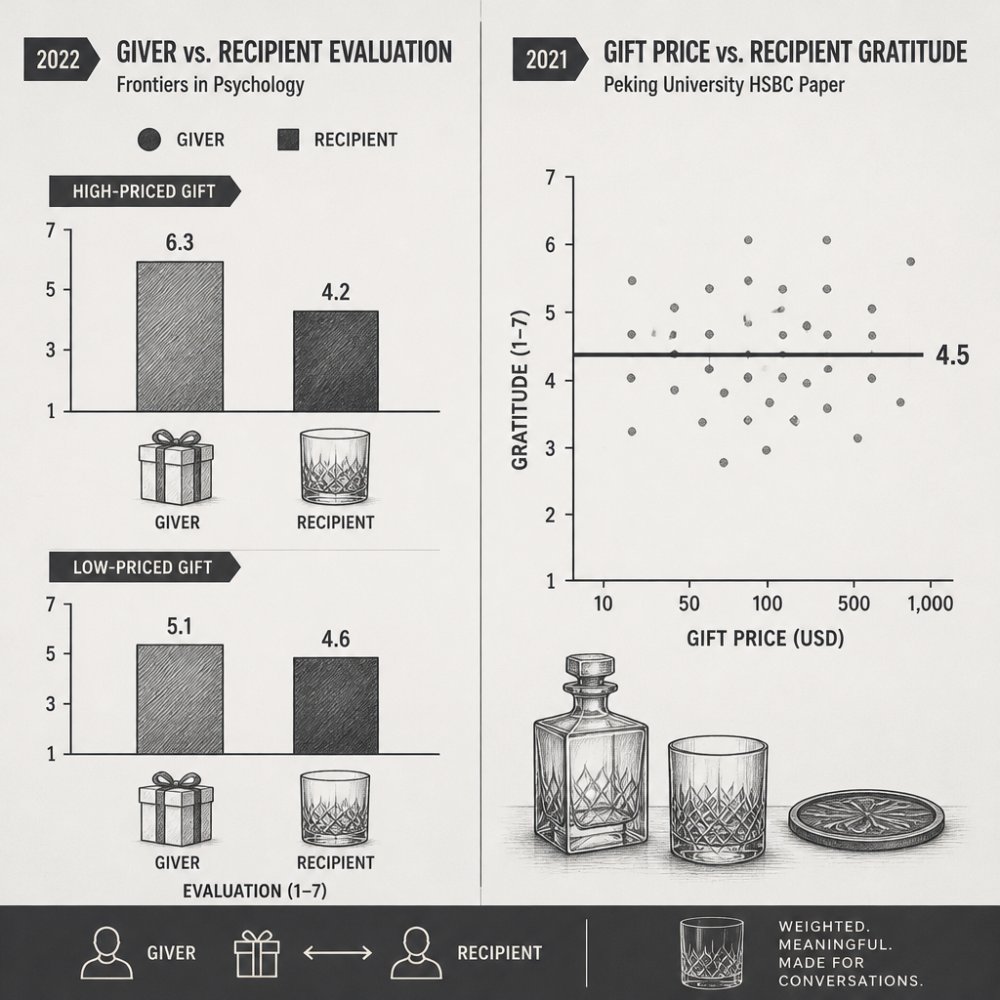
Here is where the assumption breaks. A Frontiers in Psychology study on gift pricing from 2022 found that givers rated high-priced gifts more favorably than low-priced ones, while receivers did the opposite. The two sides of the exchange are not running the same calculation.
Price is not weight, but the pattern matters. A 2021 Peking University HSBC Business School paper reported that recipients' gratitude was not significantly associated with gift price, even though recipients assumed price and appreciation moved together.
That gap has a practical cost in corporate gifting. Why standard gifts fail with senior management comes down to the same mismatch between what givers assume and what recipients value. Givers reach for weight and price as proof of thought.
The research separates how a gift feels in the hand from how much a recipient values it.
| Source | What it found | Sample or year |
|---|---|---|
| Packaging study indexed by PubMed Central | Perceived weight shaped by size, color, and material, not actual weight alone | 54 participants |
| Frontiers in Psychology study on gift pricing | Givers rated high-priced gifts more favorably; receivers did the opposite | 2022 |
| Peking University HSBC Business School paper | Recipients' gratitude not significantly associated with gift price | 2021 |
| Scientific American report on gift bundling | Adding a small gift to a larger one can lower perceived value | 2023 |
Corporate Gift Giving Etiquette: Rules That Outrank Heft
Corporate gift giving etiquette is the set of written and unwritten rules that govern what is appropriate in a business relationship. It outranks any consideration of weight, because a policy violation costs more than a light glass ever will.
The gap in most gift guides is that they treat etiquette as a manners question. In practice, the rules that matter most are compliance rules.
That is why the first question is not "how much" but "who and when." A gift to a procurement officer mid-evaluation is a different act from a thank-you to a long-standing client after a project closes.
Before weight, check these:
- Company policy on both sides. The giver's and the recipient's organizations may each have gift-acceptance rules, and the stricter one governs.
- Value limits and disclosure thresholds. Many companies cap what employees may accept and require reporting above a set amount. Stay well under the cap and disclose when required.
- Conflict of interest and open deals. A gift during an active procurement, bid, or contract negotiation is a red flag. Pause it.
- Public-sector and regulated recipients. Government employees, health care professionals, and financial-services staff often face statutory limits that override private etiquette.
- Professional boundaries. Nothing overly personal, intimate, or promotional.
- Subtle branding. A small mark is fine. A billboard is not.
The safest professional gifts are purposeful: a thank-you, a milestone, a welcome. They are tasteful, neutral, and tied to the relationship rather than the transaction.
A Practical Policy-Check Workflow Before You Buy
Most gift guides skip the boring part. Here is the workflow that prevents an awkward return, and the escalation path for when the rules are unclear or the gift is prohibited outright.
- Find the actual rule, not the summary. Start with the recipient organization's public code of conduct or gift policy. If it is not posted, ask your own compliance or legal contact to request it. The rule you need is usually in a procurement, ethics, or conflict-of-interest policy, not a general HR handbook.
- Note the spending limit and the disclosure threshold. These are often two different numbers. A gift under the cap may still require disclosure.
- Flag the relationship. Client, prospect, vendor, manager, or employee changes the rules. A vendor gift to a buyer is scrutinized more than a peer-to-peer thank-you.
- Check timing. Is a deal, bid, or performance review open? If yes, pause the gift until it closes.
- Document the decision. If the gift sits close to a limit, record what you gave, to whom, when, and why. A short note in your CRM or expense file is enough.
- Escalate when unclear, in writing. Ask compliance by email and keep the reply. A verbal approval from one contact is not cover.
When a gift is prohibited, do not force a workaround. The clean alternatives are a handwritten note, a shared experience the policy permits, or a donation in the recipient's name where that is allowed. Each clears the rule without putting the recipient in an awkward spot.
A common pattern among practitioners is to set a per-recipient limit well below the published cap and apply it consistently across a team. Consistency is its own defense: it shows the gift was appreciation, not influence.
Thoughtful Business Gifts for Leaders Who Already Have Everything
Thoughtful business gifts for leaders start with a simple admission: they do not need more things. The gift works when it fits a ritual they already keep, not when it adds clutter to a shelf.
A 2023 Scientific American report on gift bundling described research finding that adding a small gift to a larger one can lower the perceived value of the combined gift. More is not better. One well-chosen item beats a bundle.
For leaders, that means:
- Barware they will actually use for a pour at the end of the day
- Something with a story, not a logo
- A gift that starts a conversation rather than ending one
A glass built for a slow drink and a hard question does that. Browse the glassware collection to find one that fits the ritual.
Premium Whiskey Glasses for Gifting: Where Weight Earns Its Keep
Premium whiskey glasses for gifting are where weight does real work, just not the work the assumption promises. A weighted old-fashioned glass improves the drinking experience: it feels balanced, it sits steady, and it slows the pour down. That is a design benefit, not a gratitude guarantee.
A premium glass earns its keep through clarity, craftsmanship, and a base that feels intentional. The difference between a standard tumbler and an executive-grade glass shows up in the hand within seconds.
The Bourbon in the Boardroom Old Fashion Glass is a short, wide, weighted glass with the signature logo and an etched tagline on the bottom. It is built to be used, not shelved. If the question is whether a heavier glass is worth it, the answer is yes for the pour and no for the proof of thought. Those are separate jobs.
When a Gift Is Declined, Returned, or Received Unexpectedly
A declined gift is not a verdict on your taste. It is usually a policy at work. Handle it with three moves: accept the answer without pressure, ask whether a different form is allowed, and offer an alternative that clears the rules.
Common fixes:
- Swap the item for a shared experience the recipient's policy permits.
- Send a note instead. A handwritten note never violates a gift limit.
- Offer a flexible option so the recipient chooses. A gift card lets them pick without the awkwardness of a return.
If a gift arrives unexpectedly, disclose it per your own company policy. Reciprocity is the trap here: do not feel obligated to match value. A prompt thank-you note closes the loop.
Choosing Your Next Gift with The Pour
The research points one way: weight shapes how a gift feels, not how much it is valued. So choose for fit, not for heft, and let the weight be a bonus rather than the argument.
Bourbon in the Boardroom builds glassware for leaders who value the conversation after the meeting ends. Each glass carries a weighted feel, a classic short-wide design, and an etched tagline on the bottom. It is a gift that gets used, and a glass that starts the next discussion.
Get started with Bourbon in the Boardroom and give a gift that earns its place on the desk, not just in the hand. Add to cart
Frequently Asked Questions
Does a heavier gift seem more valuable?
Not reliably. A 2019 study of 54 participants found perceived weight is shaped by an object's size, color, and material as well as its actual weight, so heft alone is a weak signal. Research on the perceived value of gifts points the same way: a 2021 Peking University HSBC study found recipients' gratitude was not significantly associated with gift price, even though recipients assumed the two were linked. A weighted glass may feel substantial in the hand, but treat that as craftsmanship, not proof of appreciation.
How can you make a business gift feel thoughtful without making it expensive?
Follow corporate gift giving etiquette basics: match the gift to a specific reason (a milestone, a thank-you, a welcome), keep it moderate in price, and skip anything overly personal. A handwritten note and well-timed delivery often do more than a bigger spend. The 2022 Frontiers in Psychology study found receivers actually rated low-priced gifts more favorably than givers expected, and a 2023 Scientific American report found adding a small extra gift can lower perceived value of the bundle. One purposeful item beats a pile of extras.
Are weighted whiskey glasses good gifts for business leaders?
They can be, when the recipient drinks spirits and your company policy allows gifts in that category. Premium whiskey glasses for gifting work because the weight comes from the glass itself, not packaging tricks, and an etched detail gives it a personal edge. Check your gift-acceptance policy first, keep the presentation understated rather than promotional, and pair it with a short note. Avoid the gift if the recipient's role involves procurement decisions with your company, where a conflict of interest could be read into it.
What should you avoid when choosing a gift for a business partner?
Skip anything overly personal, intimate, or potentially offensive, and avoid gifts that look like they are angling for a favor. Under anti-bribery rules like the Foreign Corrupt Practices Act, a gift tied to a pending business decision creates real risk. Also avoid stacking multiple items: the 2023 Scientific American research found a small added gift can reduce the perceived value of the larger one. Keep branding subtle, respect dietary and cultural restrictions, and confirm the recipient's employer permits gifts before you send.