 how-to
How to Elevate Boardroom Meeting Atmosphere
Last Updated: November 7, 2026
Quick Summary
Elevate boardroom meeting atmosphere by preparing the room before anyone sits down: use dimmable lighting, slightly cool temperature, roundtable or U-shape seating, and tested screens. Then protect the conversation by sending materials three days out, labeling each agenda item decide, discuss, or inform, and making it safe to disagree.
- Send board materials at least three days before the meeting so members arrive prepared.
- Label every agenda item as decide, discuss, or inform to stop time draining on the wrong items.
- Set the room two to three degrees below comfort, since a warm room puts people to sleep.
- Call on members in a fixed rotation so the most senior voice does not anchor the room.
- Score participation, dissent, and decisions from 1 to 5 after each meeting and track the trend.
Table of Contents
- Why Boardroom Meeting Atmosphere Decides the Outcome
- How to Prepare the Room Before Anyone Sits Down
- How to Run a Board Meeting That People Actually Want to Attend
- The Board Meeting Agenda Template That Sets the Tone
- Boardroom Communication Best Practices for Hard Conversations
- Board Meeting Examples: What Good and Bad Atmosphere Look Like
- How to Audit Your Meeting Atmosphere and Measure Improvement
- Build the Room Where Better Decisions Get Made
- Frequently Asked Questions
Why Boardroom Meeting Atmosphere Decides the Outcome
A boardroom meeting is a decision-making room, and the atmosphere in that room shapes what gets decided. A tense, rushed, poorly lit space produces guarded talk and safe votes.
Most leaders treat atmosphere as a soft extra. It isn't.
Below, we'll show you exactly how to shape the room, the agenda, and the conversation so the board does its best thinking.
How to Prepare the Room Before Anyone Sits Down
Room setup is one of the simplest levers a board chair has. Get it right and a meaningful share of the atmosphere work is already done. A board-specific setup goes further than lighting and seating: it accounts for accessibility, sensory needs, hybrid participants, and confidentiality.
Start with the physical basics:
- Lighting: bright enough to read faces, not so harsh it feels like an interrogation. Dimmable fixtures let the chair drop the light during screen sharing and raise it during debate.
- Temperature: slightly cool, since a warm room puts people to sleep. A common pattern is to set it two to three degrees below comfort and let members adjust.
- Seating: a roundtable or U-shape beats a lecture layout every time. Leave at least one empty seat near the chair so a late arrival or a guest does not have to squeeze in.
Accessibility and Neuroinclusive Design
A room that excludes one member changes the atmosphere for everyone. Build accessibility in before the meeting, not after a request:
- Step-free access and clear pathways: confirm the route from the elevator to the table is wide enough for a wheelchair or mobility device, and keep bags and chairs out of it.
- Accessible seating: reserve at least one chair with arms and adjustable height at the table, not at the back of the room.
- Acoustics: hard surfaces bounce sound and make it hard for members with hearing loss to follow cross-talk. A rug, soft panels, or a table microphone helps.
Watch out: a room that looks accessible but has a locked accessible entrance or a broken elevator undoes every other signal of inclusion.
Hybrid and Remote Attendees
Most boards now run at least some meetings with a remote participant. A room built only for the people physically present will quietly sideline everyone else.
- One screen per remote attendee, or a gallery view: a single laptop at the end of the table makes remote members feel like spectators.
- A dedicated microphone and speaker: table mics pick up cross-talk; a ceiling or boundary mic keeps remote members from missing side conversations.
- A named remote facilitator: someone in the room whose job is to watch the chat and call on remote hands.
Confidentiality and the Physical Room
Boardrooms handle material that is legally sensitive. Before anyone sits down, confirm the whiteboard is wiped, the printer tray is empty, and any leftover documents are collected. Check that the door closes fully and that the room is not visible from a hallway or a neighboring office. A room that leaks information destroys the psychological safety the rest of the setup is trying to build.
Glassware and Table Setting
Glassware and table setting matter more than people admit. For teams that want the table to feel intentional, quality glassware and an executive-grade old-fashioned glass do quiet work before anyone speaks. Readers curious about why materials matter can explore what defines a premium glassware shop.
Watch out: a room that is too formal creates stiffness, and a room that is too casual reads as unprepared. Match the setting to the stakes.
How to Run a Board Meeting That People Actually Want to Attend
Running a strong board meeting comes down to one habit: protect the conversation. The chair's job is not to talk. It is to make room for the right talk.
Send materials at least three days out. Open with the decision, not the deck. Ask direct questions by name. Close every item with a clear owner and a date.
A Timed Facilitation Plan for the First 30 Minutes
A tight opening sets the tone for everything after it.
- Minutes 0-3: Welcome, confirm quorum, state the meeting objectives out loud
- Minutes 3-8: Review the agenda and flag any item that needs more time
- Minutes 8-15: Consent agenda, quick approvals, no discussion unless a member objects
- Minutes 15-28: First major decision item, framed as a question to the board
- Minutes 28-30: Recap what was decided and what comes next
This structure gives everyone undivided attention on the hard item while energy is highest. It also signals that time management is a shared value, not a threat.
The Board Meeting Agenda Template That Sets the Tone
A board meeting agenda template is a one-page plan that lists each item, its purpose, its time slot, and who leads it. The template itself sets the tone before the meeting starts.
Use this structure:
| Section | Time | Purpose | Lead |
|---|---|---|---|
| Welcome and quorum | 3 min | Open the meeting | Chair |
| Consent agenda | 5 min | Approve routine items | Secretary |
| Strategic decision item | 25 min | Debate and decide | CEO |
| Financial review | 15 min | Review performance | CFO |
| Committee reports | 10 min | Share updates | Committee chairs |
| Open discussion | 10 min | Raise concerns | All members |
| Action items and close | 5 min | Confirm owners | Chair |
Time
Label each item as decide, discuss, or inform. That single label stops the classic board trap: spending 40 minutes on an inform item and 5 on the decision that mattered.
Boardroom Communication Best Practices for Hard Conversations
Boardroom communication best practices start with one rule: make it safe to disagree. Boards that cannot disagree in the room will disagree in the parking lot. The difference between a board that debates and a board that performs agreement is rarely talent.
A few habits that work:
- Ask open questions before offering opinions
- Repeat a member's point back before challenging it
- Invite the quietest voice first, not last
Active listening is not a soft skill in a boardroom. It is how a chair finds the real risk hiding under a polite update.
Psychological Safety and Power Dynamics in the Room
Psychological safety is the shared belief that a board member can speak up without punishment. It is the single strongest predictor of honest feedback in a boardroom. Power dynamics can quietly kill it. A dominant CEO, a long-tenured chair, or a single loud voice can shut down the room without meaning to.
Chairs can counter this with specific mechanisms, not just good intentions:
- Fixed speaking order: call on members in a set rotation so the most senior voice does not always go first and anchor the room.
- Silent brainstorming before open discussion: give everyone two minutes to write their view on a card or a shared doc, then read them aloud without attribution. This surfaces dissent that would not survive a show of hands.
- Explicit dissent requests: ask, "Who sees this differently?" and then wait through the silence. The first person to speak after that pause is often the one who was holding back.
Handling Hierarchy in a Fiduciary Room
Board members carry fiduciary duties, and that changes the stakes of speaking up. A director who disagrees with a CEO may worry about the relationship, the next committee assignment, or the optics of conflict. Chairs can lower that cost by:
- Naming the duty out loud: remind the board at the top of hard items that their obligation runs to the organization, not to the CEO.
- Taking the hard item first: put the most sensitive decision at the start of the agenda, while energy and candor are highest, rather than after a long financial review.
- Closing the loop: tell the board what happened because someone raised a concern. A member who sees dissent lead to a real change is far more likely to speak up next time.
Watch out: a chair who asks for dissent and then argues with the first person who offers it teaches the room to stay quiet for the rest of the year.
A Simple Safety Check
At the close of each hard conversation, ask the board two questions on a 1-to-5 scale: "Did you feel able to say what you actually thought?" and "Did the room hear a view different from the majority?" Track the answers across meetings. A board that scores high on the first and low on the second is polite but not yet safe. A board that scores high on both has built the atmosphere that better decisions depend on.
Board Meeting Examples: What Good and Bad Atmosphere Look Like
Good and bad board meeting examples are easy to spot once you know the signals.
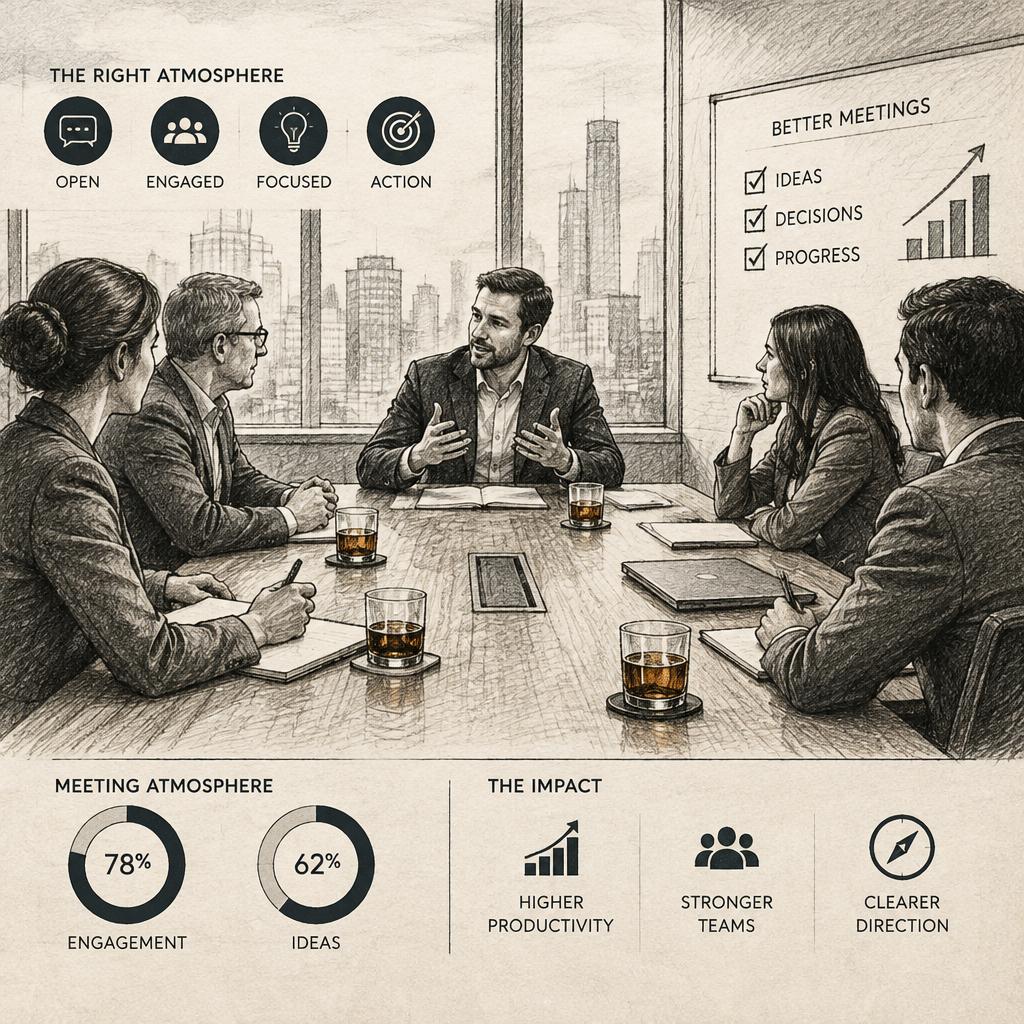
A good room looks like this: members arrive early, the agenda was read, the CEO frames the first item as a real question, two members disagree openly, and the chair thanks them for it. The board leaves with three clear decisions and named owners.
A bad room looks like this: half the board is on a laptop, the CEO presents for 30 minutes, no one asks a hard question, and the meeting ends with "we'll circle back." Nothing was decided.
Small details feed both versions. Readers thinking about how perception works at the top can go deeper on why standard gifts fail with senior management.
How to Audit Your Meeting Atmosphere and Measure Improvement
An atmosphere audit is a short, repeatable review that scores the room on a handful of observable indicators. Run it after every board meeting and track the trend.
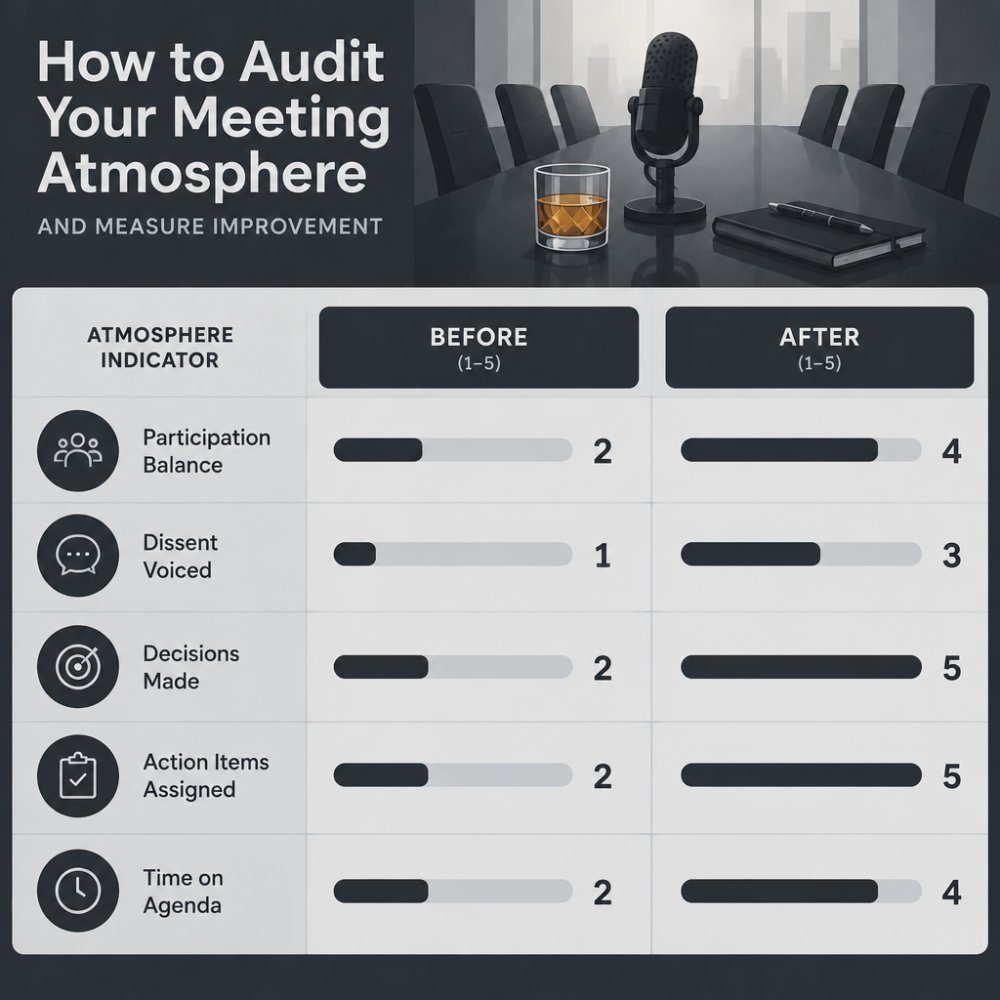
Score each indicator from 1 to 5:
- Participation balance: did every member speak at least once?
- Dissent voiced: did anyone openly disagree?
- Decisions made: how many items moved to a clear call?
Compare scores across three meetings. If dissent stays at 1 or 2, the room is too polite. If time on agenda keeps slipping, the agenda is too full. The audit turns a vague feeling into a number the chair can act on.
Build the Room Where Better Decisions Get Made
Better boardroom decisions come from rooms built on purpose: prepared, safe, and focused on the call that matters. Atmosphere is not decoration. It is the operating system of the board.
Bourbon in the Boardroom is a leadership podcast for leaders who want honest conversation about running the room. Leaders who want more can join the membership for exclusive bourbon content, community, and events.
The hardest part of a board meeting is not the agenda. It is building a room where people tell the truth.
Frequently Asked Questions
What makes a boardroom meeting atmosphere productive?
A productive atmosphere comes down to three things: people arrive prepared, every voice in the room carries equal weight, and the group leaves with decisions rather than open loops. That means a clear agenda sent in advance, a chair who actively invites dissent instead of just calling for approval, and a room setup that supports discussion. When those pieces are in place, the boardroom meeting shifts from a status report to a working session where honest feedback and direct questions are normal.
How can a chair encourage more open discussion in a board meeting?
Start by asking for disagreement before asking for consensus. A simple prompt like "what are we missing here?" pulls in perspectives that a yes-or-no vote never surfaces. Rotate who speaks first so the most senior person does not anchor the conversation. Use silent brainstorming before open discussion so quieter members form their view before hearing anyone else's. These small facilitation choices change how the boardroom meeting feels and how much honest input actually reaches the table.
What should a board meeting agenda include?
A working board meeting agenda template names each item, the decision required, who owns it, and how many minutes it gets. Put consent items first, strategic discussion in the middle when energy is highest, and executive session last. Every item should answer one question: are we deciding, informing, or discussing? If an item does not fit one of those three, it belongs in a memo, not the meeting. Sending the agenda 48 to 72 hours ahead gives board members time to prepare real input.
How do you create a positive atmosphere for a difficult board discussion?
Set the frame before the content. Open by naming the difficulty directly, state what decision the board needs to reach, and set ground rules for the conversation. Seat people so no one is physically isolated, and make sure the most affected voices speak before the most senior ones. Allow a short break if tension spikes. The goal is not to soften the topic but to make it safe to disagree about it. A boardroom meeting that handles one hard topic well builds trust for the next one.