 how-to
Why Heavy Glassware Matters in Meetings
Last Updated: October 29, 2026
Quick Summary
Heavy glassware matters in meetings because the weight in the hand signals that this is not a quick transaction, changing how people sit, how long they stay, and how seriously they take the conversation. A weighted glass reads as intention and permanence, while thin plastic cups say the meeting will be over soon.
- A weighted glass on the table signals the conversation has been deliberately set up, raising seriousness before anyone speaks.
- A heavier glass is lifted less often and sipped more slowly, which slows the pace of conversation usefully.
- Thick bases are durable, but thick rims chip when stacked carelessly or knocked against a sink edge.
- A small leadership session of four to six people rewards weight; a large all-hands event rewards lighter, stackable glassware.
- If a person cannot hold the full glass comfortably for a full minute, it is too heavy for a shared meeting room.
Table of Contents
- Why Heavy Glassware Matters in Meetings
- The Case for Executive Glassware Over Disposable Cups
- Weight, Balance, and Grip: How Glass Weight Shapes Perception
- Weighted Old-Fashioned Glasses and the Ritual of a Slow Conversation
- Glassware for Business Meetings: A Practical Selection Checklist
- The Trade-Offs: When Heavy Glassware Works Against You
- Accessibility and Ergonomics in the Meeting Room
- Choosing Your Boardroom Glassware Set
- Frequently Asked Questions
Why Heavy Glassware Matters in Meetings
A heavy glass does more than hold a drink. It changes how people sit, how long they stay, and how seriously they take the conversation. That is why heavy glassware matters in meetings: the weight in the hand signals that this is not a quick transaction.
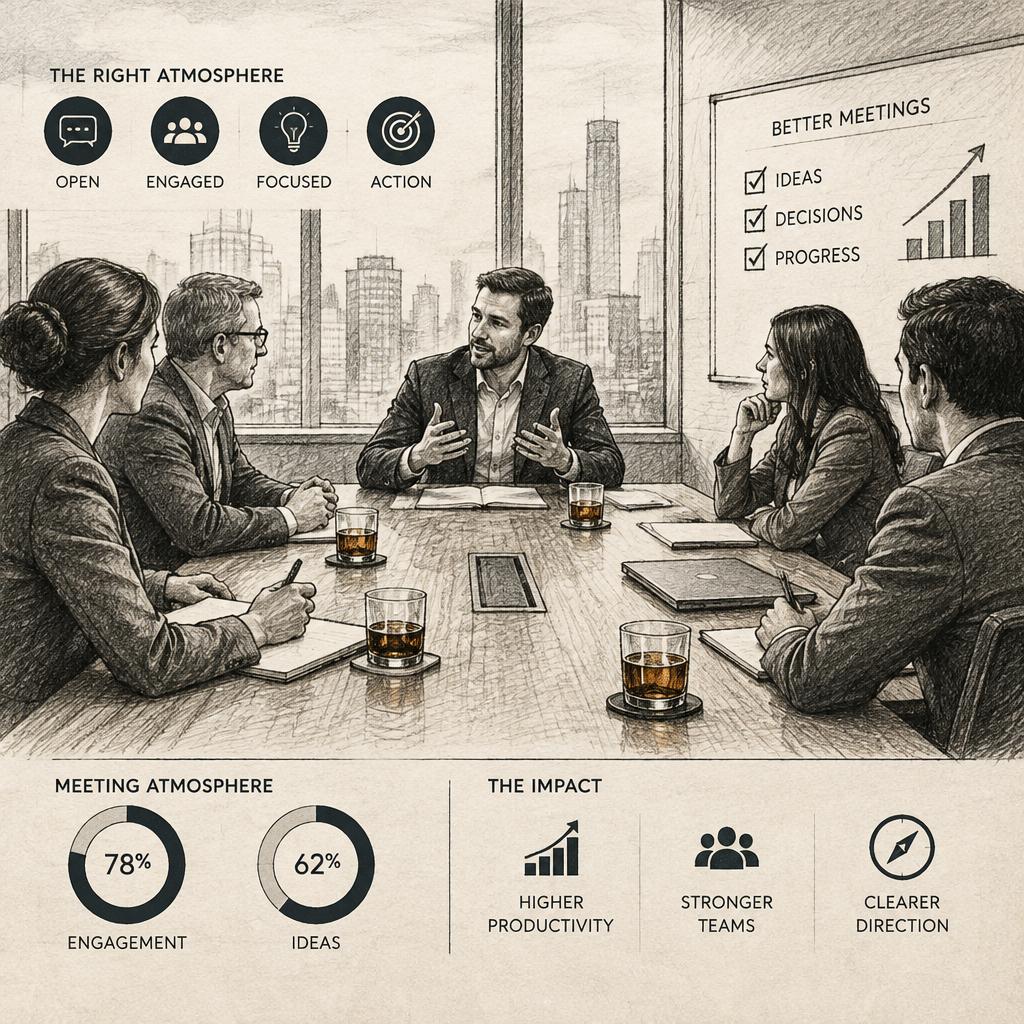
The meeting room is where deals get tested. Thin plastic cups and paper sleeves say "this will be over soon." A weighted glass says the opposite.
The Case for Executive Glassware Over Disposable Cups
Executive glassware earns its place because it survives the meeting and the years after it. Disposable cups get tossed in a bin before the room clears. A heavy old-fashioned glass stays on the shelf and shows up again next quarter.
- Disposable cups read as convenience, not care
- Weighted glass reads as intention and permanence
- Thin tumblers feel temporary and easy to knock over
Senior leaders notice this faster than anyone. Why standard gifts fail with senior management explains the pattern in more detail.
Weight, Balance, and Grip: How Glass Weight Shapes Perception
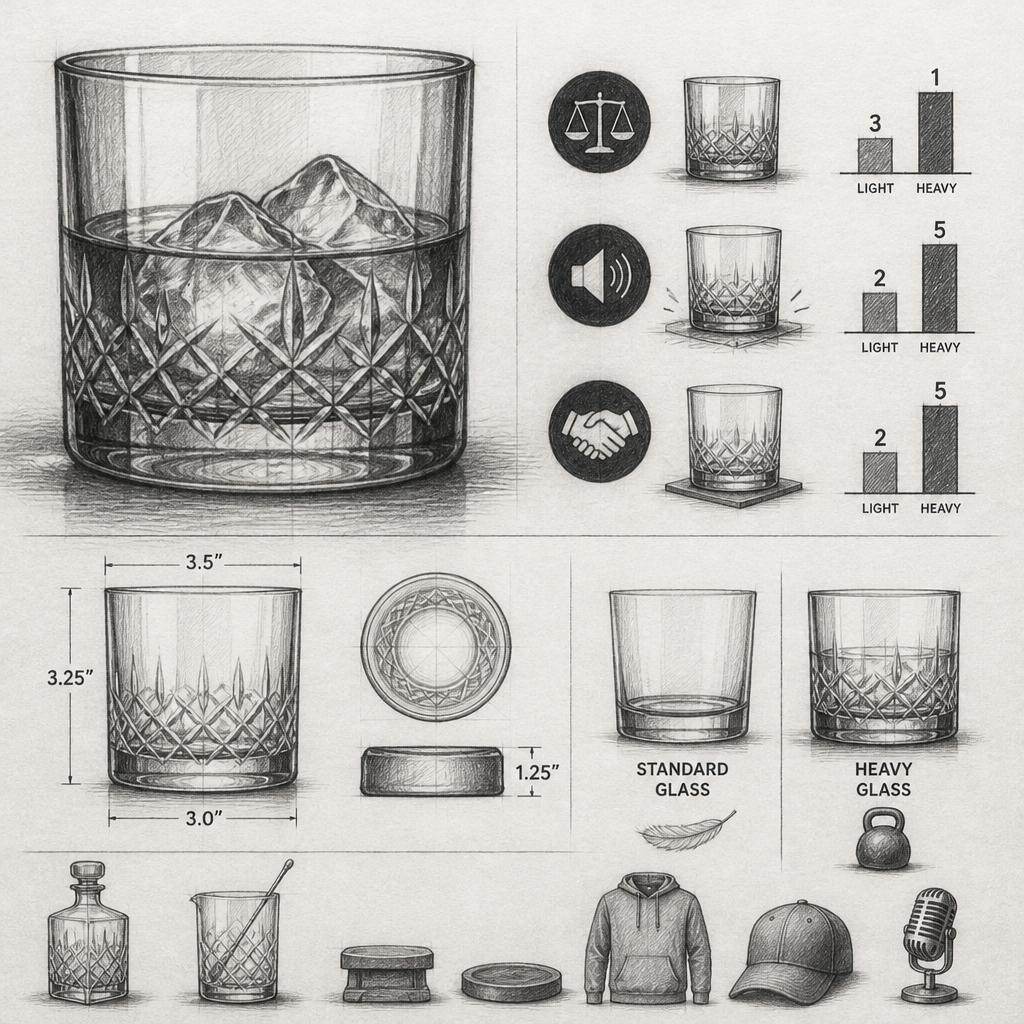
Weight, balance, and grip are the three things the hand reads before the eye catches up. A glass with a thick base feels steady. A glass that is too light feels cheap, even when it is not. A glass that is too heavy for its size feels clumsy.
Tactile perception is doing quiet work here. People judge quality by feel long before they judge it by label. A balanced glass settles into the palm and lets the drink do the talking. A badly weighted one pulls attention to itself for the wrong reasons.
- Balance means the glass does not tip when set down
- Grip means the hand wraps around it without strain
- Weight means the object feels solid without feeling like a paperweight
What the hand actually measures
When you lift a glass, three sensory channels fire at once: pressure receptors read how much surface is in contact, hand and forearm muscles register the effort to lift and hold, and the inner ear tracks how the object moves as it tilts. A heavier glass recruits more muscle effort, which the brain translates into words like "substantial," "serious," or "premium." A very light glass recruits almost none, which is why thin plastic reads as disposable even when perfectly clean.
Weight and balance cannot be judged separately. A glass can be heavy and still feel wrong if the weight sits in the bowl rather than the base, because the hand fights the top-heaviness every time it is set down. A glass can be light and still feel right if the base is dense and the walls thin, because the effort is concentrated where the fingers expect it.
Why this matters specifically in meetings
Most writing on glass weight focuses on restaurants, wine tastings, and home entertaining. The meeting room is a different setting, and the perception effects differ too.
- Formality signal. A weighted glass on the table tells everyone in the room that the conversation has been deliberately set up. That signal is read before anyone speaks, and it tends to raise the seriousness of the first few minutes.
- Confidence cue. A glass that sits flat and does not wobble lets the person holding it gesture, lean, and set it down without thinking about it. A wobbly or top-heavy glass pulls attention back to the table at exactly the wrong moment.
- Status consistency. Senior leaders have handled a lot of glassware. A heavy, balanced glass reads as chosen; a thin promotional tumbler reads as ordered in bulk. The difference is not snobbery, it is pattern recognition.
Where the evidence is strong and where it is not
Tactile weight influences quality judgments, a well-established pattern in consumer perception research that most practitioners who handle glassware daily will confirm. It is not fair to claim a specific percentage improvement in meeting outcomes, because no study measures that.
For the longer version, there is a good breakdown of what separates a premium glassware shop from an ordinary one. The short version: weight, clarity, and craftsmanship separate a standard tumbler from an executive-grade glass.
Weighted Old-Fashioned Glasses and the Ritual of a Slow Conversation
Weighted old-fashioned glasses are built for a specific kind of meeting. The short, wide bowl gives the drink room to breathe, the thick base keeps it stable on a table crowded with laptops and notebooks, and the weight in the hand slows the sip, which slows the conversation in the best way.
The Bourbon in the Boardroom Old-Fashioned Glass is built on exactly this idea. It is a classic short-wide glass with a weighted feel, a signature logo, and an etched tagline on the bottom. It gives the glass a private message that only the person holding it can read.
Glassware for Business Meetings: A Practical Selection Checklist
Glassware for business meetings should be chosen against four criteria, not against a catalog photo. The right set balances weight, grip, durability, and storage. Score each option on those four and the choice gets simple.
| Criterion | What to Check | Why It Matters | Rating Guide |
|---|---|---|---|
| Weight and balance | Does it sit flat without tipping? | A tipping glass disrupts the room | High: steady on any surface |
| Grip comfort | Does it fit the average hand? | Strain pulls focus from the talk | High: comfortable for long holds |
| Durability | Will it survive daily handling? | Breakage kills the set fast | High: thick base, sturdy walls |
| Storage footprint | Does it fit the cabinet or credenza? | Bulky glass eats shelf space | High: stacks or nests cleanly |
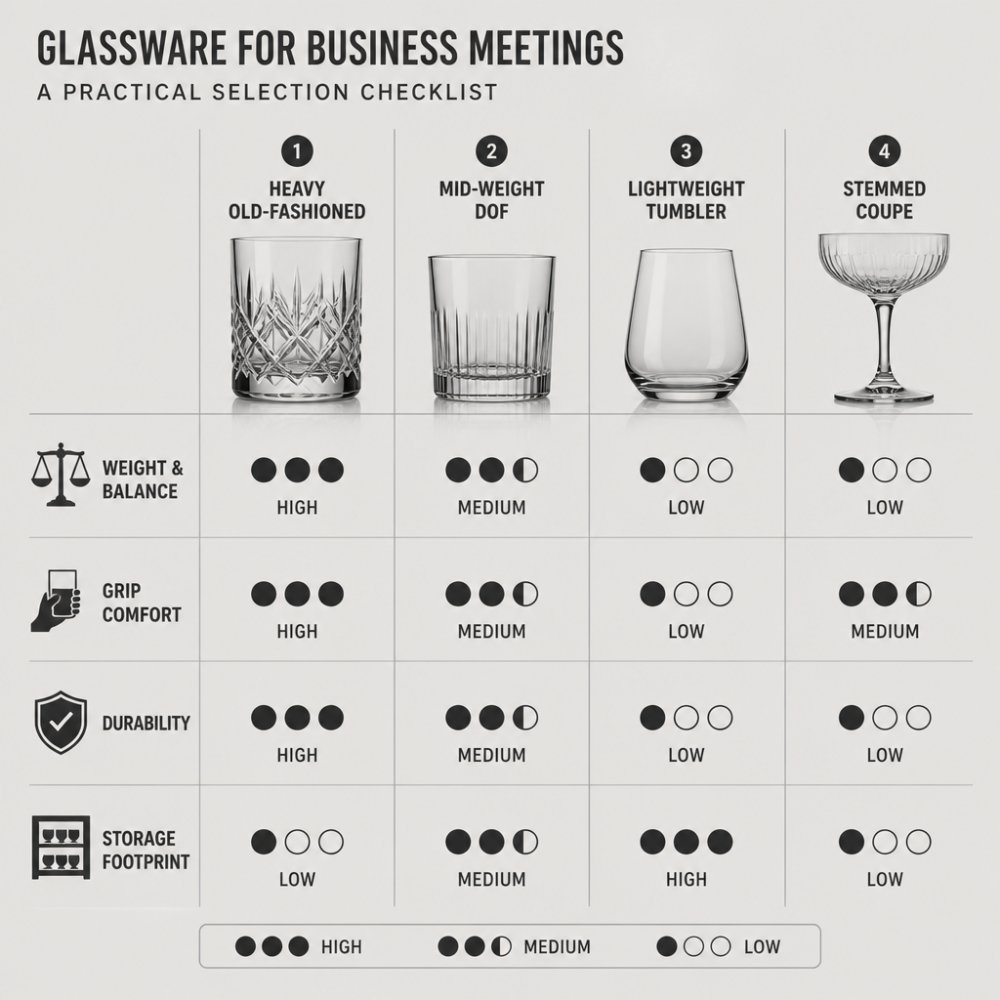
Run this checklist before buying a full set. A common mistake is ordering for looks and discovering the storage problem later.
The Trade-Offs: When Heavy Glassware Works Against You
Heavy glassware has real costs. The trade-offs show up as time, space, and replacement cycles.
Those trade-offs matter more in a meeting room than at a bar, because the room is usually shared, storage is limited, and the person washing the glasses is usually not dedicated staff.
The four operational costs, explained
- Handling time. A heavier glass takes slightly longer to lift, carry, and set down. That difference is invisible for one glass and noticeable across a tray of twenty. In a large all-hands event, the cumulative effect is slower service and longer lines.
- Storage footprint. Wide, weighted bowls do not nest as tightly as straight-sided tumblers. A set that looks compact on a shelf can consume noticeably more cabinet depth once the bowls are accounted for. Measure the credenza before ordering, not after.
- Washing and chipping. Thick bases are durable, but thick rims chip when they are stacked carelessly or knocked against a sink edge. Chips are a safety issue in a shared office and usually mean the glass is retired rather than repaired.
When the trade-off flips
The trade-off is about the ratio of ceremony to volume, not the glass itself. A small leadership session of four to six people rewards weight, because the room is quiet, the pace is slow, and the glass is handled carefully.
A useful rule of thumb: if the room holds more people than the set has glasses, the set is being used as service ware rather than as a signal, and the weight advantage shrinks.
The middle path
Most offices do not need to choose between heavy and disposable. A common pattern is a small set of weighted old-fashioned glasses reserved for seated leadership conversations, plus a larger set of lighter, stackable tumblers for everything else. The heavy set carries the signal; the light set carries the volume. Keeping the two sets visually distinct also makes it obvious which belongs in which room, reducing breakage and lost pieces.
Accessibility and Ergonomics in the Meeting Room
Accessibility and ergonomics decide whether a heavy glass actually gets used. A glass too heavy for someone with wrist or grip limits becomes a burden, not a pleasure, and one that is too wide is hard to hold for smaller hands.
- A short, wide bowl is easier to grip than a tall, narrow one
- A thick base lowers the center of gravity and reduces spills
- A comfortable rim makes drinking easier without tilting the head far back
A practical rule: if a person cannot hold the full glass comfortably for a full minute, it is too heavy for a shared meeting room. Keep the heaviest pieces for smaller, seated conversations.
Choosing Your Boardroom Glassware Set
Choosing a boardroom set comes down to matching the glass to the room and the people in it. Start with the meeting size.
Then check the practical details.
- How many people sit in the room at once?
- Where will the glasses live between meetings?
- Who washes them, and how careful will they be?
Browse the full glassware collection and pick the one that fits the room. For current pricing or a quote, visit the Bourbon in the boardroom website.
The real test is simple. If the glass makes people sit down and stay a while, it is doing its job.
Most meeting rooms are set up for speed, not for the kind of conversation that actually moves a company forward. Join the community through membership to access the conversations and content behind the podcast.
Frequently Asked Questions
Why does glassware matter in a meeting?
Glassware sets the tone before anyone speaks. A weighted old-fashioned glass in hand gives people something to hold during pauses, which slows the pace of conversation and signals that the meeting is worth their attention. Heavy glassware also reads as considered rather than disposable, and that perception carries into how attendees judge the room, the host, and the discussion itself. The glass is a small detail that shapes first impression and guest experience at the same time.
Does a heavier glass actually feel more premium?
Yes, and the reason is tactile rather than visual. A thick base and weighted bowl create stability in the hand, so the glass does not slide or tip when someone sets it down mid-sentence. That steadiness is what people read as quality. Balance matters as much as raw weight, though: a glass that is heavy at the base but top-light feels deliberate, while an evenly heavy glass can feel clumsy. Grip and rim thickness finish the impression.
What glassware is appropriate for an executive meeting?
Short, wide old-fashioned glasses are the safest choice for leadership settings. They hold water, whiskey, or a non-alcoholic serve equally well, they sit stable on a conference table, and they do not look out of place whether the meeting is at 9 a.m. or 6 p.m. Avoid stemmed wine glasses for working sessions, since stems invite spills and take up more table space. For glassware for business meetings, prioritize durability, a comfortable rim, and a design that will still look current in five years.
Are old-fashioned glasses suitable for business gatherings?
They are, provided the setting matches the glass. A weighted old-fashioned glass works for a boardroom debrief, a mentor dinner, or a small leadership gathering where conversation is the point. It is a poor fit for a large all-hands event, where heavier glassware means more restocking, more time at the bar, and less room on crowded tables. Match the glass to the room, not to the occasion's label.