 how-to
Durable Glassware for Daily Office Use: 2026 Guide
Table of Contents
- What You Need Before You Buy Durable Glassware
- Best Everyday Glassware for Break Rooms and Boardrooms
- Unbreakable Glassware: What Tritan and Thickened Glass Actually Deliver
- Borosilicate Drinking Glasses: Heat Resistance and Thermal Shock
- Dishwasher-Safe Glassware and Daily Care Routines
- Common Mistakes When Choosing Durable Glassware for Offices
- Total Cost of Ownership and Building a Glassware Set
- Frequently Asked Questions
Last Updated: October 5, 2026
What You Need Before You Buy Durable Glassware
Durable glassware for daily office use is drinkware built to survive repeated washing, constant handling, and the occasional hard knock against a conference table.
Before comparing materials, settle three questions: who washes the glasses, how they get stored, and whether hot drinks are in the mix. Those answers narrow the field faster than any spec sheet.
A common mistake is buying on looks alone. A thin, elegant tumbler photographs well and chips on the second dishwasher cycle.
Best Everyday Glassware for Break Rooms and Boardrooms
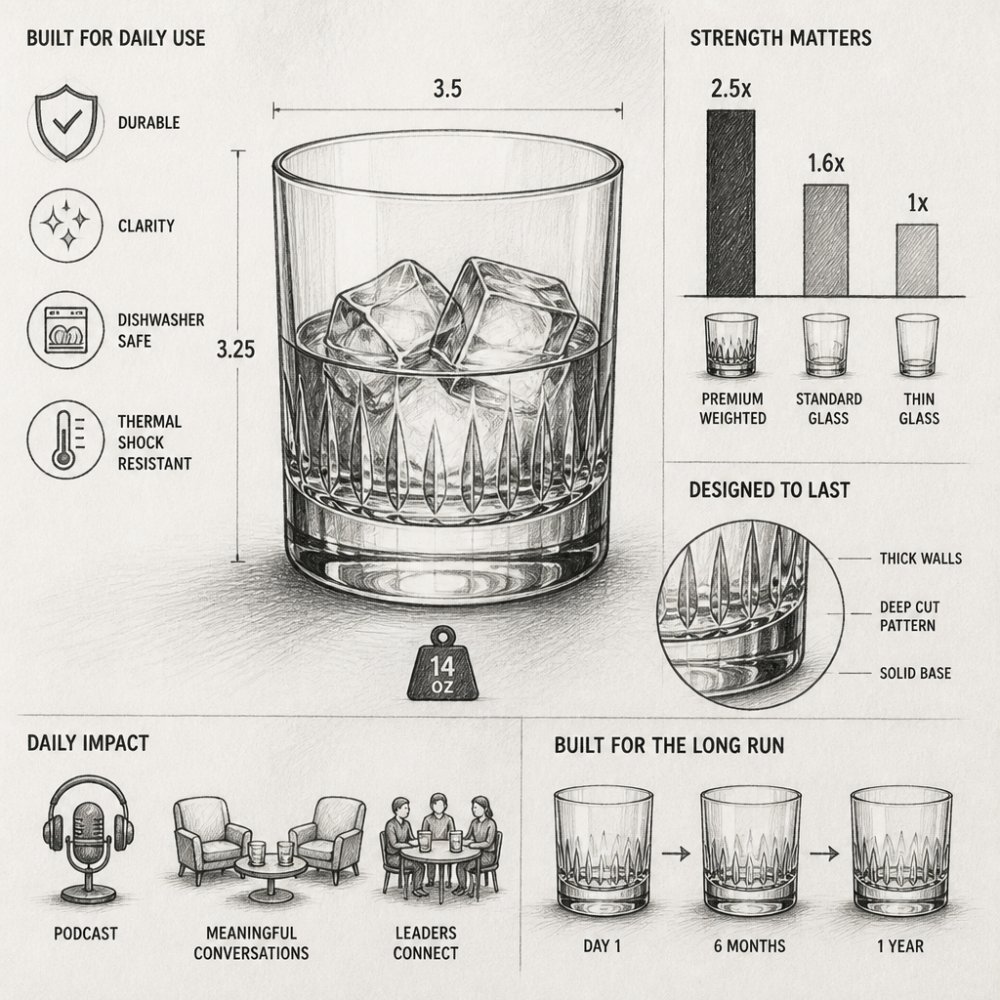
The best everyday glassware for offices balances three things: a heavy base that resists tipping, a wall thick enough to survive handling, and a shape that stacks or stores without chipping. Short, wide tumblers win in break rooms; taller highball glasses suit boardroom water service.
Material choice drives everything else. Here is how the main options compare.
| Material | Breakage Resistance | Heat Resistance | Dishwasher Safety | Clarity | Best For |
|---|---|---|---|---|---|
| Soda-lime glass | Low | Low | Moderate | High | Low-traffic rooms |
| Tempered glass | High | Moderate | High | High | Break rooms |
| Borosilicate glass | Moderate | High | High | Very high | Hot and cold drinks |
| Tritan plastic | Very high | Low | High | Moderate | High-risk areas |
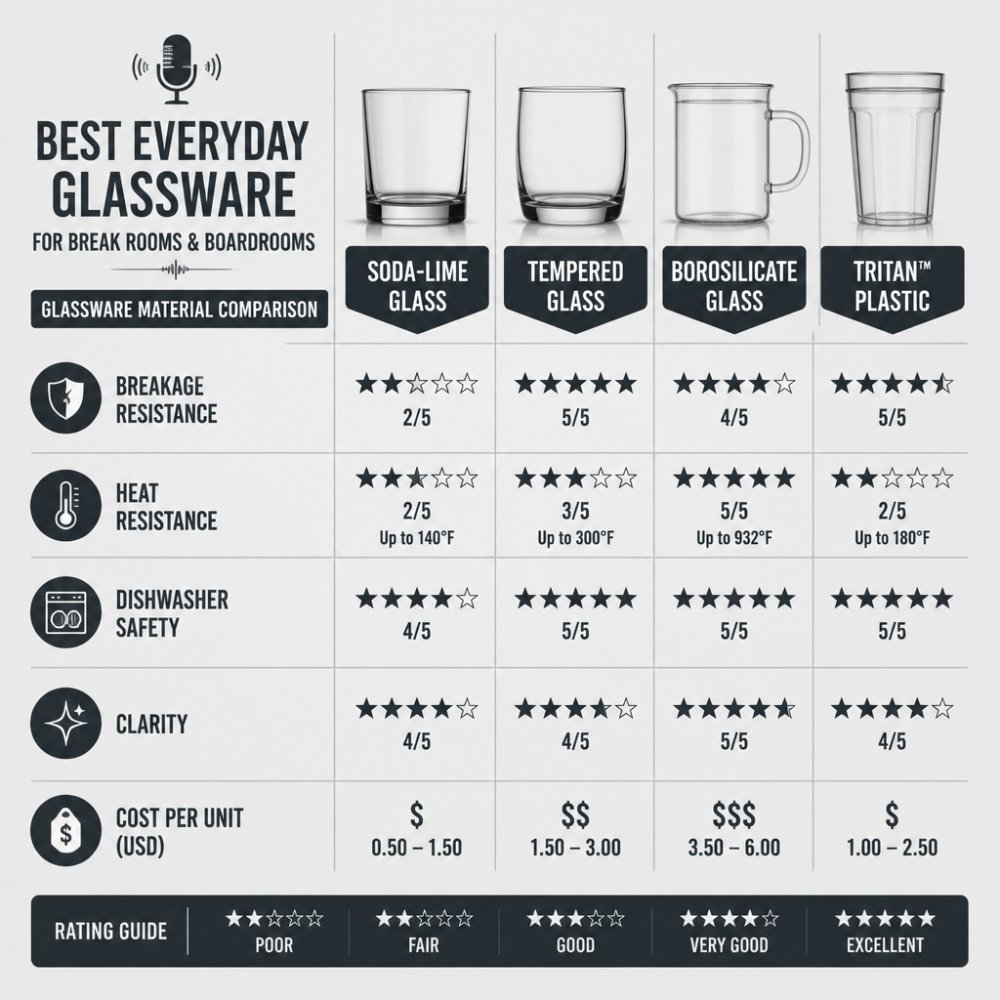
For a mixed-use office, tempered glass handles the break room and borosilicate covers the boardroom coffee service. That split costs more upfront and saves on replacements.
Unbreakable Glassware: What Tritan and Thickened Glass Actually Deliver
Unbreakable glassware is a marketing term, not a material category. Nothing glass is truly unbreakable. Tritan plastic and thickened glass reduce breakage dramatically, but they solve different problems.
Tritan is a BPA-free, food-grade copolyester. It resists impact far better than glass and survives drops that would shatter a tumbler. The trade-off is clarity and feel: it never quite reads as premium, and it scratches over time.
Thickened glass takes the opposite approach. A heavy base and thicker walls add weight and stability, which matters in a boardroom where a tipped glass ends a meeting. According to U.S. Food and Drug Administration guidance on food-contact materials, food-contact plastics and glass must meet specific safety standards, so verify any material claim before buying in bulk.
Borosilicate Drinking Glasses: Heat Resistance and Thermal Shock
Borosilicate drinking glasses handle temperature swings that crack ordinary glass. The material has a low thermal expansion rate, so it tolerates hot coffee poured into a room-temperature glass without shattering.
That property is called thermal shock resistance, and it is the main reason borosilicate costs more than soda-lime. For an office serving both iced water and hot tea from the same set, it removes a real risk.
Borosilicate is lead-free and dishwasher safe in most cases, though very hot commercial cycles still stress any glass over time. It also stays clearer than plastic after repeated washing.
The catch: borosilicate is not impact-proof. It resists heat far better than it resists a drop onto tile. Pair it with a heavy base for stability, and keep a plastic backup set for high-traffic areas.
Dishwasher-Safe Glassware and Daily Care Routines
Dishwasher-safe glassware is labeled for machine washing, but "safe" does not mean "unaffected." Heat, detergent, and loading habits determine how long a set lasts.
A simple routine extends lifespan considerably:
- Rinse glasses before loading to prevent residue baking on
- Load glasses upside down, spaced so they do not knock together
- Use a lower-temperature cycle when the dishwasher offers one
- Skip the heated drying cycle for borosilicate and thin glass
- Hand wash any glass with an etched design to protect the finish
Etched logos and taglines sit on the surface, so abrasive detergents and hard water dull them faster than plain glass. Hand washing specialty pieces preserves the detail.
Common Mistakes When Choosing Durable Glassware for Offices
Most office glassware fails for predictable reasons, and almost none of them are about the glass itself. They are about treating a workplace like a home kitchen. A shared break room has different traffic, different cleaning, and different storage than a kitchen cabinet, and the buying mistakes follow from that.
The first mistake is buying one set for every use. A glass that works for iced water rarely works well for hot coffee, and forcing it shortens its life. Split the job: one set for cold service, one for hot.
Office-specific missteps to avoid:
- Ignoring the shared-kitchen reality. Glasses get grabbed, carried to desks, and left half-full on conference tables. A heavy base and a short, wide profile survive that better than a tall, thin tumbler that tips when someone bumps a desk.
- Underestimating storage. Break-room cabinets are shallow and crowded. Glasses that stack without rim-to-rim contact chip far less than ones crammed shoulder to shoulder. Measure the cabinet before ordering.
- Skipping the desk-use question. If people carry drinks back to their desks, weight and grip matter more than elegance. A glass that feels secure in one hand gets dropped less.
- Choosing style over base weight. Thin, elegant tumblers photograph well and tip easily. In a room where people stand, talk, and gesture, stability beats silhouette.
- Ignoring capacity. A standard highball holds around 12 ounces, which suits water and juice but crowds a cocktail or a large iced tea. Match capacity to the drinks your team actually pours.
- Forgetting the hot-drink risk. Pouring hot coffee into a room-temperature soda-lime glass can crack it. Keep a separate borosilicate set for hot service.
- Buying too few. A set of two for a team of ten forces constant hand washing and increases handling, which increases breakage. Size to the room, not to the shelf.
- Overlooking hygiene in shared use. Glasses that sit damp in a cabinet or get wiped with a shared towel stay less clean than ones that air-dry on a rack. Storage that supports drying matters as much as the glass.
Total Cost of Ownership and Building a Glassware Set
Total cost of ownership for office glassware is not the shelf price. It is the purchase plus replacements, breakage, cleaning effort, and the staff time spent reordering. A cheaper set that breaks twice a year often costs more in the long run than a durable set bought once, because the hidden costs compound.
Think in replacement cycles rather than sticker price. A set that survives three years of daily break-room use beats a set replaced every year, even when the durable option costs more upfront. The math is about how often you re-buy, not what you pay the first time.
Cleaning effort belongs in the calculation too. Glasses that cloud or etch in a hot commercial dishwasher get replaced early, and etched sets look tired long before they break. A material that tolerates your actual wash cycle lasts longer than one that only tolerates a gentle home cycle.
Size the set to the room, not to the shelf:
- Break room: roughly one glass per regular user, plus a buffer for guests and breakage.
- Boardroom: a small set of four to six for water service, kept separate from general use.
- Hot drinks: a dedicated borosilicate set so cold-service glasses are not pressed into hot duty.
- High-risk areas: a small Tritan set for spots where drops are likely, such as near a coffee station or a standing-height counter.
- Backup: a few spares so a single break does not force an immediate reorder.
A practical way to compare options is to score each candidate on four things: how often it needs replacing, how much effort it takes to keep clean, how well it stores in your actual cabinet, and how it feels in the hand during desk use. The option that wins on all four usually wins on total cost, even if it is not the cheapest per unit.
For offices that want a set that doubles as a conversation piece, the brand's weighted, short-wide old-fashioned glasses with an etched tagline on the bottom are built for boardroom use. Add to cart to see what fits your room.
Frequently Asked Questions
What is the most durable type of glassware for an office?
Borosilicate glass and Tritan plastic lead on breakage and heat resistance. Borosilicate handles thermal shock from hot coffee to ice water, while Tritan resists drops and chips. Standard soda-lime glass is cheaper but chips more often under daily office use. For a boardroom that needs to look refined, borosilicate drinking glasses offer the best balance of durability and clarity.
Is borosilicate glass durable enough for everyday drinking?
Yes. Borosilicate glass resists thermal shock far better than standard soda-lime glass, so it handles hot tea, iced water, and dishwasher cycles without cracking. It is also lead-free and food-grade. The main trade-off is cost per unit, but lower replacement frequency usually offsets that over a year of office use.
How should shared office glassware be cleaned and stored?
Run dishwasher-safe glassware on a normal cycle with a gentle detergent, and load glasses upside down so water does not pool in the base. Store them on a lined shelf or in a cabinet with dividers to prevent rim chips. Keep a small tray near the coffee station so glasses do not stack, which is the most common cause of breakage in shared kitchens.
What features make glassware suitable for daily office use?
Look for a heavy base for stability, a thickened wall for impact resistance, a 12-ounce capacity that suits water, coffee, and juice, and a shape that fits standard cup holders and dishwasher racks. Dishwasher-safe glassware with a smooth rim and no painted decoration holds up best. Weighted old-fashioned styles also resist tipping during meetings.
Choosing durable glassware for daily office use comes down to matching material to the room, then caring for the set so it lasts. Bourbon in the boardroom builds weighted, short-wide old-fashioned glasses designed for leadership moments, with a premium feel, a signature logo, and an etched tagline on the bottom of each glass. Get started with Bourbon in the boardroom and give your boardroom a set that earns its place.