 how-to
Executive Gift Etiquette Rules: A How-To Guide
Table of Contents
- Understanding Business Gift Etiquette Fundamentals
- Step 1: Verify Company Gift Policies and Compliance Requirements
- Step 2: Select Appropriate Gifts for Business Partners
- Step 3: Set Your Gift Budget and Timing
- Step 4: Crafting Business Gift Note Examples
- Step 5: Plan Delivery and Packaging for Discretion
- Gift Giving to Government Officials: Special Considerations
- Frequently Asked Questions
Last Updated: October 12, 2026
Understanding Business Gift Etiquette Fundamentals
Executive gift etiquette is about respect, boundaries, and professional judgment. The rules protect both giver and recipient from misunderstandings, conflicts of interest, and compliance violations.
The core principle: gifts should feel like genuine gestures, not obligations or attempts to influence decisions. Company policies, federal disclosure rules, and state requirements all shape what's appropriate.
Step 1: Verify Company Gift Policies and Compliance Requirements
Checking recipient company policies
Most organizations have written policies about gifts employees can accept, some prohibit them entirely, others set dollar limits.
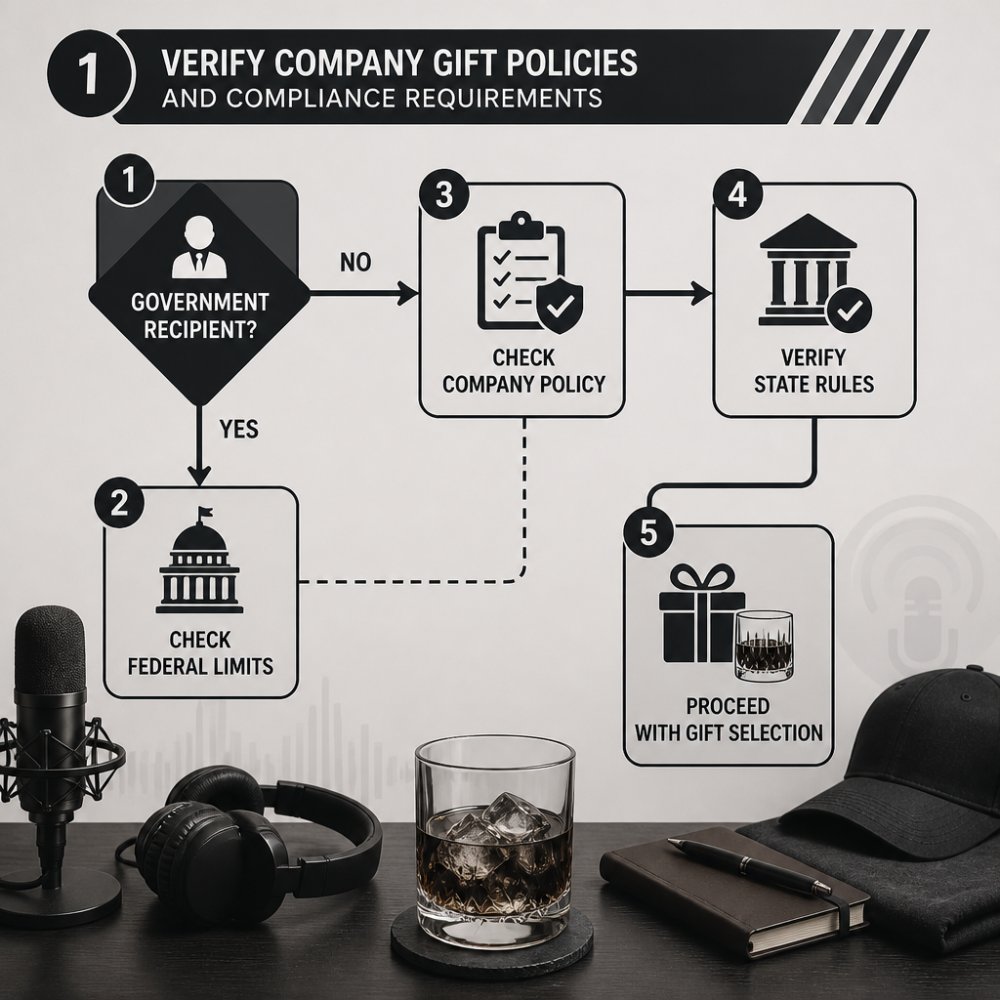
The safest approach is to ask directly: "I'd like to send you a gift to thank you for our partnership. Are there any company policies I should know about?"
If you can't ask directly, check the recipient's company website, many publish ethics or compliance guidelines publicly. Look for "gift policy," "ethics guidelines," or "employee conduct rules."
When you read a policy, look for four specific things:
- The dollar threshold. Many private-sector policies set a per-gift cap, often in the range of $50 to $150, and a separate annual aggregate cap per source.
- The source restriction. Some policies ban gifts only from vendors, suppliers, or anyone with a pending bid or contract, not from everyone.
- The reporting requirement. Some employers require the recipient to log or disclose any gift above a nominal value, even if it's allowed.
- The approval path. A few require the recipient's manager or compliance office to sign off before acceptance.
If the policy is silent on any of these, treat silence as a caution flag rather than permission.
Understanding federal and state disclosure rules
Federal employees face strict gift limits set by the U.S. Office of Government Ethics (OGE) and applied by individual agencies.
Those numbers are the baseline, not the ceiling, agencies can impose tighter rules, and some prohibit outside gifts entirely. Assume a government recipient cannot accept a business gift unless you have confirmed otherwise in writing.
State and local government employees have their own rules. Many states mirror the federal framework; others are stricter, and a handful effectively ban gifts from anyone outside immediate family. Check the specific agency's ethics office.
Private sector employees have more flexibility, but their employer's policy still controls what they can accept.
Disclosure and recordkeeping on your side
Compliance runs both directions. If your organization has a gift log, procurement policy, or anti-bribery statement, your outgoing gift may need recording even when the recipient's policy allows it, typically the recipient, item, approximate value, and business purpose.
One habit prevents most problems: before you buy, write a sentence explaining the legitimate business purpose. If it sounds like an inducement, it's the wrong gift.
The timing test
Compliance isn't only about value, it's about context. A gift sent during an active bid, renewal negotiation, or regulatory review invites scrutiny even when the amount is trivial; the same gift after a contract closes carries far less risk. When in doubt, wait until the decision window has passed.
Step 2: Select Appropriate Gifts for Business Partners
Matching gifts to recipient preferences and role
The best gifts reflect what the recipient actually values. A wine collector appreciates quality spirits differently than someone who doesn't drink. An executive who travels constantly needs different items than one who stays local.
Start by observing: what does this person talk about, display in their office, or mention?
Match the gift to the relationship level:
- Casual business contact: A modest, professional item. Nothing personal.
- Regular partner or vendor: Something slightly more thoughtful. A quality item they'll use.
- Close mentor or major client: A more significant gift. Something that shows you've paid attention to their interests.
Role matters too. Senior executives appreciate distinctive or useful items; mid-level managers receive fewer, so a thoughtful one stands out; individual contributors often prefer practical items over status symbols.
Avoiding common gift-giving mistakes
The biggest mistake is choosing based on what you like, not what the recipient values. A beautiful bottle means nothing to someone who doesn't drink.
Avoid anything too personal. Gifts that reference appearance, relationships, or intimate details cross professional boundaries. Clothing, fragrances, and jewelry often feel too intimate for business relationships.
Never give cash or gift cards. They feel transactional. They raise compliance questions. They lack thoughtfulness.
Avoid items with strong political, religious, or cultural messages. Keep gifts secular and apolitical.
Don't give gifts that imply a favor in return.
Step 3: Set Your Gift Budget and Timing
Budget decisions depend on relationship depth and industry norms. A thank-you gift for a vendor differs from a holiday gift for a major client.
Industry practice varies: tech companies often send modest gifts, financial services firms tend toward higher-value items, and professional services fall in between.
Timing shapes how a gift is received. Holiday gifts feel expected; mid-year gifts stand out as more personal; gifts before negotiations start look suspicious.
Send gifts when the gesture feels natural. After a successful project. At year-end. When marking a business anniversary. When thanking someone for exceptional support.
Never rush delivery, a gift arriving weeks late looks like an afterthought.
Step 4: Crafting Business Gift Note Examples
Writing authentic, professional messages
A handwritten note transforms a gift from a transaction into a gesture. Keep it brief, genuine, and specific.
Keep the tone warm but professional. Avoid casual language, inside jokes, or excessive gratitude.
End with a brief, forward-looking statement about the relationship you hope to continue.
A strong note takes three to five sentences. Nothing longer. Here are patterns that work:
"I wanted to thank you for the time you invested in our project this year. Your insights made a real difference in how we approached the challenge. I hope this small gift brings you some enjoyment. Looking forward to working together again."
"As we wrap up the year, I wanted to acknowledge the partnership we've built. Your team's support has been invaluable.
"Thank you for taking the time to mentor me over the past year. Your guidance shaped how I approach leadership.
Personalizing your note without overstepping
Personalization means showing you know the recipient, not making assumptions about their life.
Reference something they've mentioned, a book they recommended, a hobby they described, a goal they shared.
Avoid references to appearance, family situation, or personal relationships unless they've raised them repeatedly. When in doubt, keep it professional.
The most powerful personalization is specificity about your working relationship, a particular project, a conversation that stuck with you, a specific way they've helped.
Step 5: Plan Delivery and Packaging for Discretion
How a gift arrives matters as much as what it is. For executive recipients, logistics are where most well-intentioned gifts go wrong.
Confirm the address before you ship
Never send an executive gift to a guessed address, business addresses change, and packages to old offices sit unclaimed or get returned. Confirm the current address through the recipient's assistant, a recent email signature, or a direct question, and include full name, title, and department on the label so reception can route it correctly.
Work with the assistant, not around them
Senior executives rarely handle their own mail; their assistant or chief of staff is the gatekeeper, and treating that person well is part of the etiquette. A short note, "I'd like to send something to [Name] as a thank-you; is there a preferred delivery window or address?", confirms logistics and signals respect for the assistant's role.
If you don't know the assistant's name, ask, using it is a small courtesy that gets remembered.
Timing the delivery
Mid-morning on a weekday works well. Avoid early morning, late afternoon, Friday afternoons, and known busy periods, earnings calls, board meetings, end-of-quarter crunches, unless the gift is tied to that event.
For holiday gifts, ship early enough to arrive before the office closes for the season, late-December packages often sit in mailrooms until January.
Office delivery versus home delivery
Send gifts to the recipient's office unless they've explicitly asked otherwise. Office delivery keeps the gesture professional; home delivery can feel too intimate and may be unwelcome.
The exception: if the employer prohibits gifts at work, or the recipient suggests a home address, follow their lead. Never send to a home address you found through indirect means.
Remote and distributed recipients
For remote relationships, ship directly and send a brief email letting them know the gift is coming so it doesn't arrive unexplained. If they work from home, confirm the address and ask whether a delivery signature is required.
For recipients in another state, check shipping restrictions on consumables, alcohol, perishables, and some specialty goods carry state-by-state rules that can cause a package to be refused at the door. If unsure, choose a non-restricted alternative.
Packaging that signals respect
Professional packaging shows respect and signals thought. Use quality wrapping or a branded box, and include the handwritten note inside rather than taped outside where anyone can read it.
For sensitive relationships, consider discreet delivery. Some executives prefer gifts delivered to their assistant, unopened; others ask for a home address. Ask if uncertain, a one-line question is far less awkward than a misdelivered package.
If the gift is refused or returned
Sometimes a gift comes back, a policy you couldn't verify, a shipping restriction, or a recipient who prefers not to accept. Handle it gracefully: don't resend, don't ask why, and don't treat it as a personal slight. A short note, "Understood completely, no obligation at all. Looking forward to continuing our work together", closes the loop without pressure.
If the refusal was policy-driven, consider a non-material alternative: a charitable donation in the recipient's name, a shared experience, or a simple thank-you note.
Gift Giving to Government Officials: Special Considerations
Federal employees cannot accept gifts from people or companies with business before their agency. Assume any business-related gift is prohibited.
State and local rules vary. Some states follow federal guidelines closely. Others impose their own limits.
The safest approach: verify the specific agency's policy before sending anything. Most publish ethics guidelines online.
If you're unsure, don't send a gift. A simple thank-you email or phone call works just as well.
Sending executive gifts requires planning, respect, and attention to detail.
At Bourbon in the boardroom, we understand that meaningful gifts strengthen professional relationships.
Frequently Asked Questions
What should you write in a note with an executive gift?
Keep your business gift note examples brief, sincere, and professional. Reference a specific shared experience or professional accomplishment, state your reason for giving the gift clearly, and sign with your full name and title. A handwritten card adds authenticity; aim for 3-5 sentences. Avoid over-personalizing or making assumptions about the recipient's personal life. The note should reinforce the professional relationship, not blur boundaries.
When is it appropriate to send an executive a gift?
Send executive gifts at natural business milestones: closing a major deal, completing a successful project, year-end holidays, or after a productive partnership period. Timing matters, gifts sent too early in a relationship can feel presumptuous, while those sent too late may seem obligatory. Avoid sending gifts during contract negotiations or when the outcome is uncertain. Check the recipient's company calendar for bonus season or earnings announcements, which signal good timing for gratitude gifts.
How do you check a company's gift policy before sending an executive gift?
Contact the recipient's HR department directly or ask your business contact informally about their company's gift acceptance rules. Many organizations post policies on their employee handbook or ethics page. Look for caps on gift value, prohibited item categories, and disclosure requirements. If you cannot find written policy, err on the side of caution: choose modest, professional gifts and include a brief note explaining your intent. Document your inquiry in case questions arise later.
What are the rules for gift giving to government officials?
Federal employees cannot accept gifts valued over $20 from any single source per year, with limited exceptions for awards and certain items. State and local officials follow their own rules, often more restrictive. Gifts to elected officials or those in decision-making roles face additional scrutiny. Always research the specific agency or state before sending. When in doubt, offer a modest, impersonal gift or skip the physical gift entirely in favor of a professional thank-you note. Disclosure may be required by the recipient.