 how-to
How to Facilitate Executive Board Meetings Effectively
Table of Contents
- Why Executive Board Meeting Facilitation Matters
- Setting Clear Meeting Objectives and Desired Outcomes
- Building an Executive Board Meeting Agenda Template That Works
- Board Meeting Facilitation Techniques for Alignment and Engagement
- Board Meeting Time Management: Keeping Discussion Focused
- Making Decisions and Resolving Disagreements
- Documenting Board Meeting Action Items and Minutes
- Measuring Meeting Effectiveness and Continuous Improvement
- Frequently Asked Questions
Last Updated: October 5, 2026
Why Executive Board Meeting Facilitation Matters
Effective board meetings don't happen by accident. They require intentional design, clear leadership, and a structured approach from start to finish. Many organizations treat board meetings as a necessary formality, a box to check rather than a strategic opportunity.
The best-run organizations treat board meetings as their most important leadership ritual. These meetings set direction, align key stakeholders, and create accountability. The difference between an effective board meeting and a mediocre one often comes down to one thing: deliberate facilitation.
Facilitation isn't about controlling the room or pushing a predetermined outcome. It's about creating space for honest dialogue, ensuring every voice is heard, and moving from discussion to decision without losing momentum.
This guide covers the complete playbook for how to facilitate executive board meetings effectively, from pre-meeting preparation through post-meeting follow-up.
Setting Clear Meeting Objectives and Desired Outcomes
Before sending the first agenda item, define what success looks like. Too many board meetings lack clarity on their purpose. Participants show up without knowing what they're supposed to decide, approve, or discuss.
Start by asking: What decisions does this board need to make? What information do they need to make them? What alignment must happen for the organization to move forward?
Your meeting objectives should be specific and measurable:
- Approve the 2027 budget
- Decide between two acquisition targets
- Review and update the three-year strategic plan
- Resolve disagreement on market expansion priorities
Desired outcomes go deeper. They describe the state you want to reach by the end of the meeting.
Write these objectives and desired outcomes down. Share them with board members before the meeting. This sets expectations and gives people time to prepare their thinking.
Building an Executive Board Meeting Agenda Template That Works
A strong agenda is the backbone of board meeting facilitation. It structures the discussion, allocates time, and signals priorities.
Your agenda should follow this structure:
Opening (5-10 minutes): Brief context-setting and ground rules for the meeting.
Consent agenda items (10-15 minutes): Routine approvals that don't require discussion. Board members review these in advance and approve them without debate unless someone raises a concern.
Discussion items (30-40 minutes): Topics requiring dialogue, input, and collaborative thinking.
Decision items (15-20 minutes): Items that require a board vote or formal approval.
Closing (5 minutes): Recap of decisions, action items, and next steps.
Keep the agenda visible throughout the meeting. Reference it to stay on track. When someone raises an off-topic point, acknowledge it and note it for a future meeting. This keeps discussion focused without dismissing input.
Pre-Read Materials and Advance Preparation
Pre-read materials are non-negotiable. They allow board members to come prepared, reduce meeting time spent on background, and improve decision quality.
For each agenda item, provide:
- A one-page executive summary (never more than two pages)
- Supporting data or analysis
- The specific decision or approval being requested
- Any background context board members need
Send pre-read materials at least five business days before the meeting. This gives people time to digest information and form initial thoughts.
Your pre-read should answer the question board members will ask: "Why are we discussing this now?" Make the business case clear. Show the stakes. Help them understand what decision you need from them.
Board members who come prepared participate more actively and ask sharper questions. The meeting moves faster because you're not explaining basics. Decisions are better because people understand the context.
Scheduling, Quorum, and Logistics
Board meeting logistics matter more than most facilitators realize. They affect attendance, engagement, and decision quality.
Schedule board meetings at the same time each month or quarter. Consistency helps people block time and prepare. Avoid early morning or late afternoon slots when energy dips.
Confirm quorum before starting. Know your bylaws and governance requirements. If you lack quorum, you cannot make binding decisions. Check attendance as people arrive and have a backup plan if key members are missing.
For virtual or hybrid meetings, test technology 15 minutes early. Ensure everyone can see, hear, and participate. A technical glitch derails facilitation faster than almost anything else.
Send calendar invitations with meeting materials attached. Include dial-in details, video conference links, and any access codes. Make it easy for people to show up prepared.
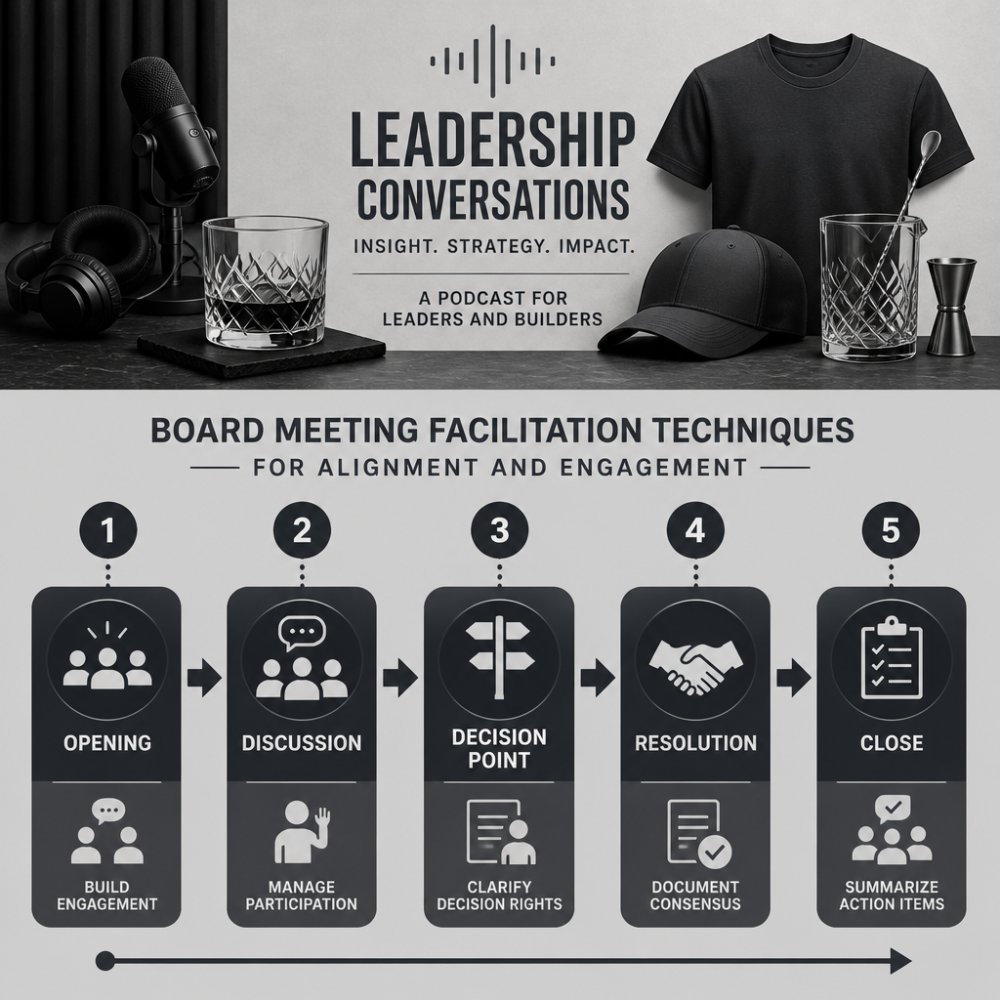
Board Meeting Facilitation Techniques for Alignment and Engagement
Facilitation techniques determine whether your board meeting generates alignment or creates frustration. The techniques you use during the meeting shape how engaged people feel and how quickly you move toward decisions.
Opening with Intention and Icebreakers
The first five minutes of a board meeting set the tone for everything that follows. Start with intention.
Begin with a brief welcome that acknowledges the meeting's purpose. Then use an icebreaker to shift people's mindset from email and calendars into focused conversation. This doesn't mean asking people to share their favorite vacation. It means creating a moment of connection.
A strong icebreaker for board meetings might be:
- "What's one decision you made this week that you're proud of?"
- "What's one thing you've learned from a board member in this room?"
- "What's one area where you think our organization could be bolder?"
These icebreakers take two minutes and serve a purpose. They get people thinking, talking, and engaged before you dive into heavy topics. They also surface perspectives you'll need during discussion.
Managing Participation and Handling Dissent
Board meetings often feature power imbalances. The CEO carries more weight than others. Longtime board members dominate. Newer members stay quiet.
Use explicit techniques to manage participation:
Invite quiet voices: "We haven't heard from Sarah yet on this. Sarah, what's your take?" Naming someone directly removes the barrier to speaking up.
Limit dominant voices: "Thanks for that perspective. Let's hear from someone who hasn't spoken yet." This is direct but necessary.
Separate the idea from the person: When disagreement surfaces, frame it as a difference in perspective, not a personal conflict.
Acknowledge strong emotions: If someone is frustrated or passionate, name it. "I can see this matters a lot to you.
Dissent is healthy. Boards that suppress disagreement make worse decisions. Your job is to invite dissent and channel it toward better thinking, not toward conflict.
When someone disagrees, ask: "What would need to be true for you to support this decision?" This shifts the conversation from positions to interests.
Board Meeting Time Management: Keeping Discussion Focused
Board members are busy. Respect their time by keeping the meeting focused and moving.
Assign a timekeeper. This person watches the clock and signals when you're approaching the time limit for each agenda item. Build in a five-minute buffer between items so you don't run late.
When discussion drifts, redirect it. "This is interesting, but it's outside our scope for today. Let's note it for a future meeting." This isn't dismissive. It's respectful of everyone's time.
Some topics will need more time than planned. Be willing to extend discussion on critical decisions. But shorten or defer lower-stakes items to stay on track overall.
End on time. If you're running over, ask the board: "Should we extend, or should we table this for next month?" Give them the choice.
Making Decisions and Resolving Disagreements
Board decisions should be deliberate and documented. Vague decisions create confusion and accountability gaps.
Clarifying Decision Rights and Authority
Before you ask for a decision, clarify who has the authority to decide. Some decisions require board approval. Others require CEO approval with board input. Still others are informational, the board is consulted but doesn't vote.
Make this explicit: "This decision requires board approval. We need consensus or a formal vote." Or: "This is informational. The leadership team will decide, but we want your input."
When decision rights are clear, people know their role. They participate at the right level. Decisions move faster because there's no ambiguity about what you're asking for.
Building Consensus Without Losing Momentum
True consensus means everyone agrees. Consensus-seeking means you explore perspectives until you reach a decision everyone can live with, even if it's not their first choice.
Use a simple process:
- Present the options clearly.
- Ask for questions and concerns.
- Invite each person to state their position.
- Look for common ground.
- Test for consensus: "Can everyone support moving forward with this decision?"
If someone says no, ask why. Often their concern is addressable. If not, you may need to escalate or table the decision.
Board decisions don't always need to be unanimous. Many governance structures allow for majority votes. If you're using a vote, be clear about the voting threshold before you ask for votes.
Document the decision immediately. Who decided what? When? What was the vote? What happens next? This clarity prevents misunderstandings later.
Documenting Board Meeting Action Items and Minutes
Minutes are your record of what happened. They protect the organization legally and create accountability for follow-up.
Assign someone to take minutes during the meeting. They should capture:
- Decisions made and their vote count
- Action items with owners and deadlines
- Key discussion points (not verbatim transcripts)
- Dissenting views if they're significant
- Attendance and any absences
Minutes don't need to be comprehensive. They need to be clear and accurate. A one-page summary is often better than five pages of detail.
Action items are critical. Every decision should produce action items. Every action item needs an owner and a deadline.
Format action items clearly:
- Action: What needs to happen?
- Owner: Who is responsible?
- Deadline: When does it need to be done?
- Status: Is it on track?
Share minutes within 48 hours of the meeting. This keeps momentum and ensures accuracy while details are fresh. Board members can flag errors or clarifications before minutes are finalized.
Review action item status at the start of each meeting. This creates accountability and keeps decisions from stalling.
Measuring Meeting Effectiveness and Continuous Improvement
The best facilitators measure whether their meetings actually work. They ask: Are decisions being made? Are they good decisions? Is the board aligned? Do people leave energized or drained?
After each meeting, ask board members for quick feedback:
- Did you have what you needed to make good decisions?
- Did everyone have a chance to be heard?
- Did we stay focused and end on time?
- What should we do differently next time?
Look for patterns. If people consistently say the agenda was unclear, fix your pre-read process.
Track decision velocity. How long does it take to move from identifying a problem to making a decision?
Most importantly, assess alignment. After the meeting, do board members understand what was decided? Do they support the decision? Are they committed to moving it forward?
Facilitating executive board meetings effectively is one of the highest-use skills a leader can develop.
Frequently Asked Questions
How long should an executive board meeting last?
Most executive board meetings run 90 minutes to 2 hours. Shorter meetings (under 60 minutes) rarely allow adequate discussion of complex governance or strategic decisions. Longer meetings (over 3 hours) cause fatigue and reduce engagement. Structure your agenda so critical items receive focused time without unnecessary filler. Virtual meetings often benefit from slightly shorter windows due to screen fatigue.
What are the best board meeting facilitation techniques for managing dominant personalities?
Set participation norms at the start: invite input from quieter members explicitly, use round-robin formats for specific agenda items, and establish time limits per speaker. Redirect monopolizers respectfully: 'That's valuable insight, let's hear from others on this before we move forward.' Use techniques like written input or breakout discussions to balance airtime. Strong facilitation prevents one voice from drowning out the leadership team's collective wisdom.
How should board meeting action items and minutes be documented?
Assign a dedicated minute-taker to capture decisions, not every word spoken. Document what was decided, who owns each action item, and the deadline. Use a consistent template so minutes are scannable. Distribute draft minutes within 24 hours while discussion is fresh, and confirm accuracy before filing. Clear documentation ensures accountability and provides a governance record for compliance and future reference.
What's the most effective executive board meeting agenda template structure?
Start with opening remarks and objectives (5 minutes), move through pre-read discussion items (bulk of time), reserve time for decision-making and alignment, then close with action items and next steps. Allocate time proportionally: governance/compliance items first, strategic decisions second, operational updates last. Include pre-read materials 48 hours in advance so executives arrive prepared. A clear agenda template prevents scope creep and keeps desired outcomes in focus.