 how-to
What Is the Etiquette for Giving Corporate Gifts?
Last Updated: October 24, 2026
Quick Summary
The etiquette for giving corporate gifts starts with checking the recipient's company gift policy before choosing anything. Confirm the recipient type, spending limit, and any conflicts of interest, then document the gift. Keep corporate gifts modest, non-cash, and tied to a genuine relationship moment.
- Run a five-step policy check covering recipient type, written policy, spending limit, conflicts, and documentation.
- Never route around a policy by shipping to a home or splitting a gift into smaller shipments.
- Avoid cash equivalents, overly personal items, loud branding, and alcohol without checking first.
- The 3-gift rule caps gifts to the same recipient at three per year, each with a clear reason.
- If a gift is declined, thank them, follow their rules, and do not resend it.
Table of Contents
- Start With the Company Gift Policy, Not the Gift
- Business Gift Etiquette Dos and Don'ts
- How to Choose Appropriate Gifts for Business Partners
- Corporate Gift Message Examples That Sound Human
- Budget, Fairness, and the 3-Gift Rule
- When a Corporate Gift Is Declined or Received Unexpectedly
- Choosing a Corporate Gift That Earns a Place in the Room
- Frequently Asked Questions
Start With the Company Gift Policy, Not the Gift
The etiquette for giving corporate gifts starts with one question: what does the recipient's company allow? Corporate gifts are items of value given in a business context, and the rules around them exist to prevent conflicts of interest and bribery risk.
Most people pick the gift first and worry about the rules later. That order is backwards. A thoughtful gift that breaks a gift-acceptance policy puts your contact in an awkward spot.
So before browsing, do the boring part. Check the rules.
A Practical Policy-Checking Workflow
Run this five-step check before you buy anything:
- Confirm the recipient type. Client, prospect, employee, manager, or vendor. Each may fall under different rules. A public-sector employee, for example, is usually governed by stricter gift limits than a private-company buyer.
- Look up the written policy. Start with the recipient organization's website, procurement, ethics, or compliance pages often publish gift policies. If nothing is posted, ask your contact to point you to the right document. Do not assume silence means permission.
- Check the spending limit. Many organizations set a per-gift or annual gift value cap for employees who accept gifts. Ask for the number in writing so you can document it.
- Screen for conflicts of interest. Is there an open contract, bid, negotiation, or renewal in play? If so, pause. A gift during an active procurement can be read as an attempt to influence, even if your intent is pure.
- Document the gift. Log what was given, to whom, when, and the stated business reason. A simple spreadsheet is enough.
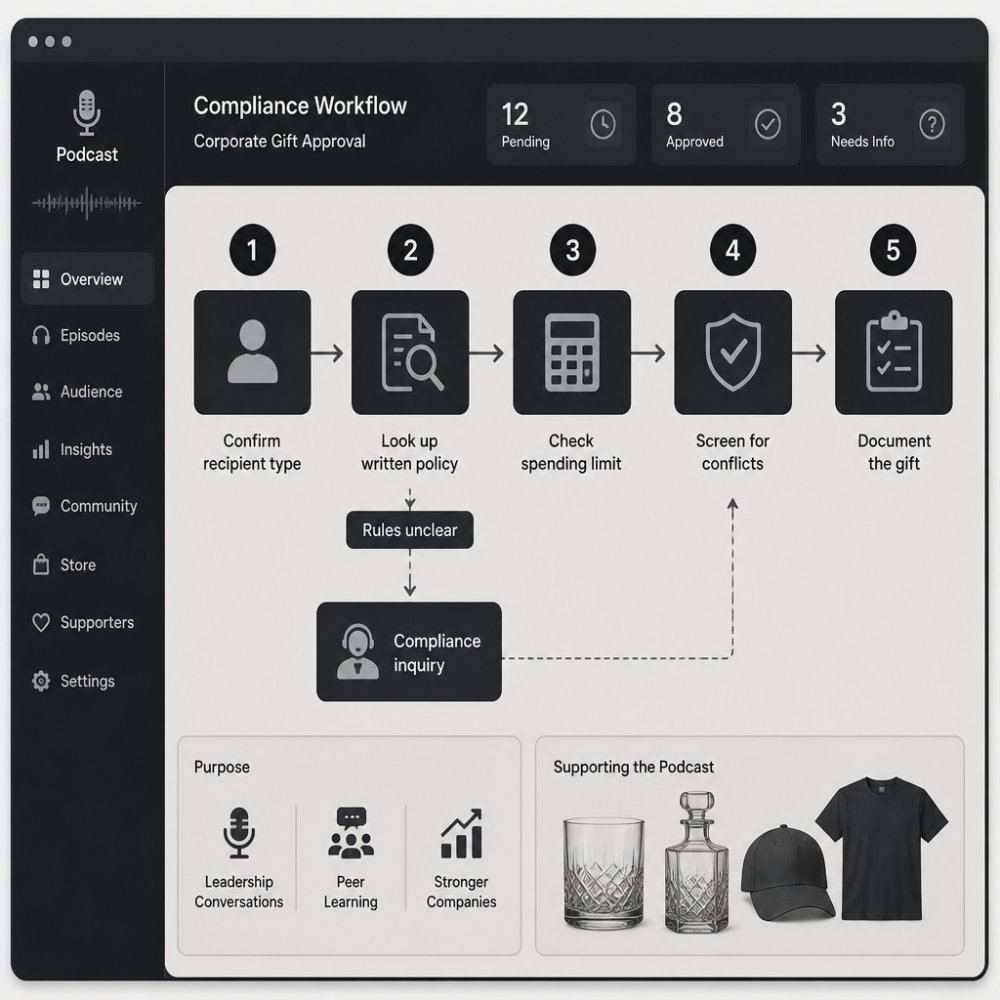
That last step matters more than people think. A simple gift log protects everyone if questions come up later, and it makes the next gift easier to justify.
What to Do When the Rules Are Unclear
Ask. A short email to your contact or their compliance team beats guessing. Something like: "We'd like to send a small token of appreciation. Is there a policy we should follow, and is there a value limit we should stay under?"
That question is normal. Procurement teams field it often, and they respect the ask. If no one will confirm, default to the conservative choice: a modest, non-cash item with subtle branding, or a shared experience like a team lunch instead of an individual gift.
Anti-Bribery and Public-Sector Rules
Ordinary appreciation and improper influence can look similar on the surface, so it helps to know where the line sits.
For state and local government recipients, rules vary by jurisdiction and agency, and many publish their own ethics codes.
A practical rule of thumb: if the recipient works for a government body, a regulated entity, or an organization in an active procurement with you, treat the gift as a compliance question first and a relationship gesture second.
Business Gift Etiquette Dos and Don'ts
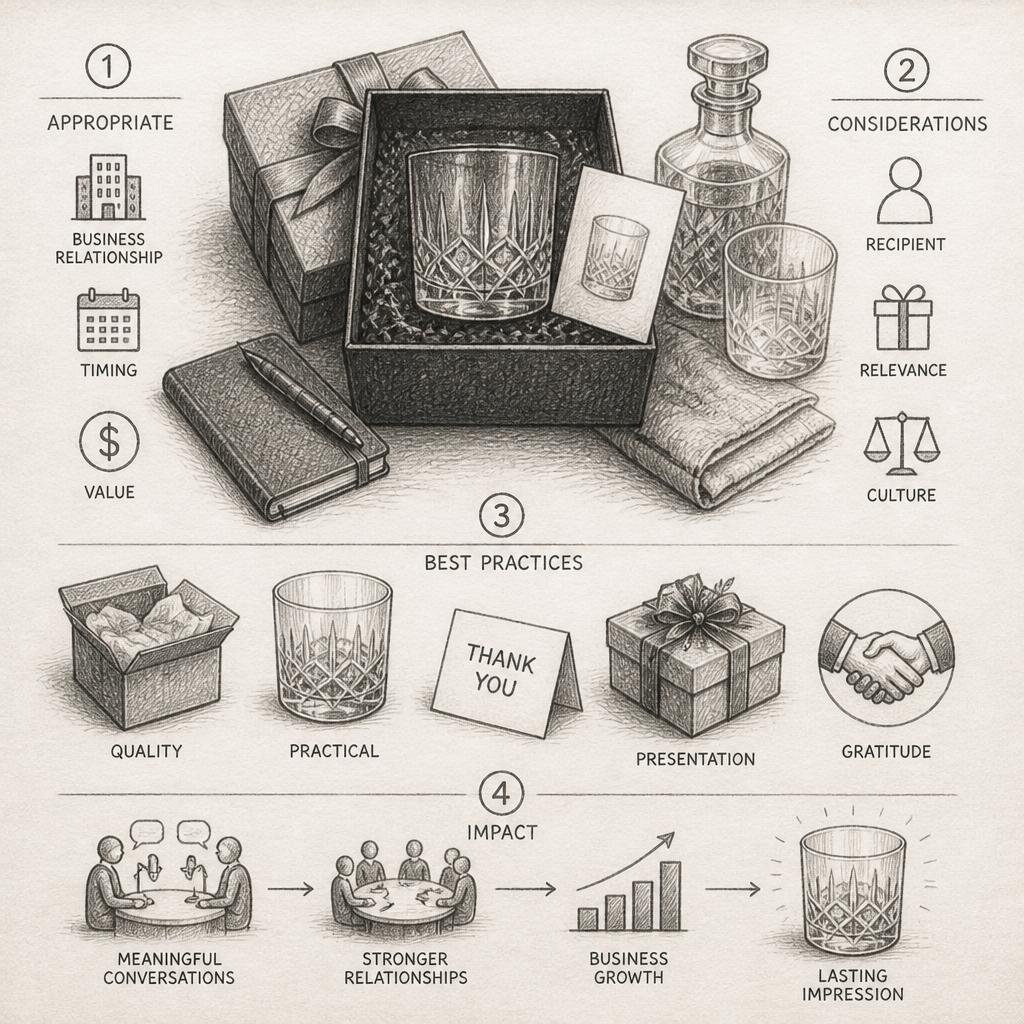
Business gift etiquette dos and don'ts come down to one idea: the gift should feel like gratitude, not a transaction. Keep it professional, moderate, and clearly tied to a real relationship moment.
Here is the short version:
Do:
- Keep the gift value moderate and within any stated spending limit
- Choose something useful or consumable
- Include a handwritten note
- Time delivery around a genuine milestone or thank-you moment
- Respect dietary restrictions and cultural sensitivity
Don't:
- Give cash or cash equivalents
- Choose overly personal items like clothing in someone's size or perfume
- Make the branding loud and promotional
- Give during an active bid or negotiation
- Send alcohol without checking first
That alcohol point deserves a pause. Barware and spirits are popular business gifts, but not everyone drinks. A recipient in recovery, a religious restriction, or a workplace policy can turn a well-meant bottle into a problem.
How to Choose Appropriate Gifts for Business Partners
Appropriate gifts for business partners share three traits: they fit the relationship stage, they match the recipient's world, and they carry subtle branding at most. A first meeting and a ten-year partnership do not call for the same gesture.
Start with the relationship, not the catalog. A prospective client gets a low-value welcome gesture. A long-standing partner can receive something more considered.
For a deeper look at why generic swag falls flat with senior leaders, this breakdown of why standard gifts fail with senior management is worth reading before you shortlist anything.
A Decision Framework by Relationship and Occasion
Use two questions to narrow the choice: who is the recipient to you, and what moment are you marking? The intersection usually points to one or two sensible options.
| Recipient | Good fit | Skip |
|---|---|---|
| Prospective client | Small welcome item, coffee meeting | High-value gifts |
| Long-term client | Keepsake barware, quality notebook | Logo-heavy swag |
| Employee | Recognition item, team experience | Cash equivalents |
| Manager | Consumable gift, handwritten note | Overly personal items |
| Vendor | Modest thank-you item | Gifts during contract talks |
Then match the occasion. A welcome, a milestone, a holiday, and a plain thank-you each call for a different tone.
If you want to browse real options, the shop carries barware and apparel that supports the cause.
Remote, International, and Culturally Diverse Teams
Modern teams are rarely in one place, and that changes the etiquette. Three practical considerations:
- Shipping and customs. Cross-border gifts can trigger duties, customs declarations, and delays. A gift that arrives weeks late or with a surprise fee attached is worse than no gift. Check whether the recipient's organization will accept a shipment at the office, and confirm what the carrier will require at the border.
- Dietary and cultural restrictions. Food and drink gifts are common, but alcohol, pork, caffeine, and certain sweets are off-limits for some recipients. A neutral, non-consumable item, drinkware, a quality notebook, a desk object, sidesteps the issue entirely.
- Inclusive alternatives. For remote teams, a shared experience such as a virtual coffee or a team lunch credit can replace individual gifts and avoid the appearance of favoritism. When in doubt, offer a choice rather than guess.
A useful habit: keep a short note in your gift log about each recipient's preferences and restrictions, so the next person who gifts to them does not start from zero.
Corporate Gift Message Examples That Sound Human
Corporate gift message examples work best when they sound like a person wrote them, because a person did. Skip the formal stiffness. Name the specific thing you appreciate.
Try these:
"Thanks for the straight answers during the review. Made the whole process easier. Enjoy this one on us."
"Congrats on the launch. Ten years of watching you build things, and it never gets old."
"Welcome to the team. First round's on us, whenever you're ready."
Three rules for any message: keep it short, reference something real, and sign it by hand. A gift with a generic "thanks for your business" card reads like a mail merge. A gift with two specific sentences reads like a relationship.
Budget, Fairness, and the 3-Gift Rule
A per-recipient budget keeps gifting fair and defensible. Set one number per relationship tier, write it down, and stick to it. If two clients sit at the same tier, they get comparable gifts. Fairness protects you from awkward comparisons and keeps spending predictable.
The 3-gift rule is a simple guardrail: no more than three gifts to the same recipient in a year, and only when each has a clear reason. A welcome gift, a milestone thank-you, and a holiday gesture. That's the pattern. Anything beyond it starts to look like influence rather than gratitude.
Gift value should stay moderate relative to the relationship. A vendor relationship does not justify an extravagant item, and extravagance invites scrutiny. When in doubt, go smaller and add a better note.
When a Corporate Gift Is Declined or Received Unexpectedly
A declined gift is not a rejection of you. It usually means a policy, a disclosure requirement, or a personal preference.
If the gift is returned, do not resend it. Log the outcome and note the recipient's preference so no one repeats the mistake next year.
Receiving an unexpected gift has its own etiquette. If a gift card is the practical fallback when preferences are unknown or a gift is declined, a gift card lets the recipient choose without pressure.
Choosing a Corporate Gift That Earns a Place in the Room
The best corporate gift earns a place in the room, not a spot in a drawer.
That is the thinking behind The Pour's classic old-fashioned glassware: a weighted, short-wide glass with a subtle logo and an etched tagline on the bottom.
Gifting well is a discipline: check the policy, match the recipient, keep it moderate, and write a note that sounds like you. Do those four things and the gift does its job.
Frequently Asked Questions
What are the guidelines for giving corporate gifts?
Start with the recipient's written policy, then keep the gift modest, professional, and clearly tied to a reason such as thanks or a milestone. Avoid cash, overly personal items, and anything that could look like an attempt to influence a decision. Branding should be subtle rather than promotional, and every gift should come with a short handwritten note. When rules are unclear, ask the recipient's compliance or procurement contact before you buy, not after.
What is the 3-gift rule for corporate gifting?
The three-gift rule is a simple fairness check: give no more than three gifts to any one recipient in a year, and keep each one tied to a distinct reason such as a holiday, a work anniversary, or a project milestone. It stops gifting from becoming a running stream of favors and makes it easier to explain your spending if anyone asks. Apply the same count across similar roles so no one feels singled out.
What should you avoid when giving a boss a gift?
Skip anything that reads as a bid for favor: cash, gift cards at high values, alcohol if you are unsure of their preferences, and items that are overly personal such as clothing or perfume. Avoid gifts that put them in an awkward spot with their own policy. A shared team gift with a modest, useful item and a signed card from the group is safer than one lavish present from a single person.
How do you politely decline a corporate gift?
Thank the giver warmly, name the reason plainly, and offer an alternative. Something like, 'This is genuinely kind, and I am not able to accept gifts under our policy. I would love to keep it as a team thank-you instead.' If the item is perishable or shared, suggest it go to the office. Follow up with a written note so the relationship stays warm and the refusal is clearly about policy, not about the person.
Gifting gets complicated fast when policies, budgets, and recipient preferences all pull in different directions. Bourbon in the boardroom makes the selection part simpler with weighted old-fashioned glasses, subtle branding, and an etched tagline that turns a gift into a talking point. Get started with Bourbon in the boardroom and give something that stays in the room.